


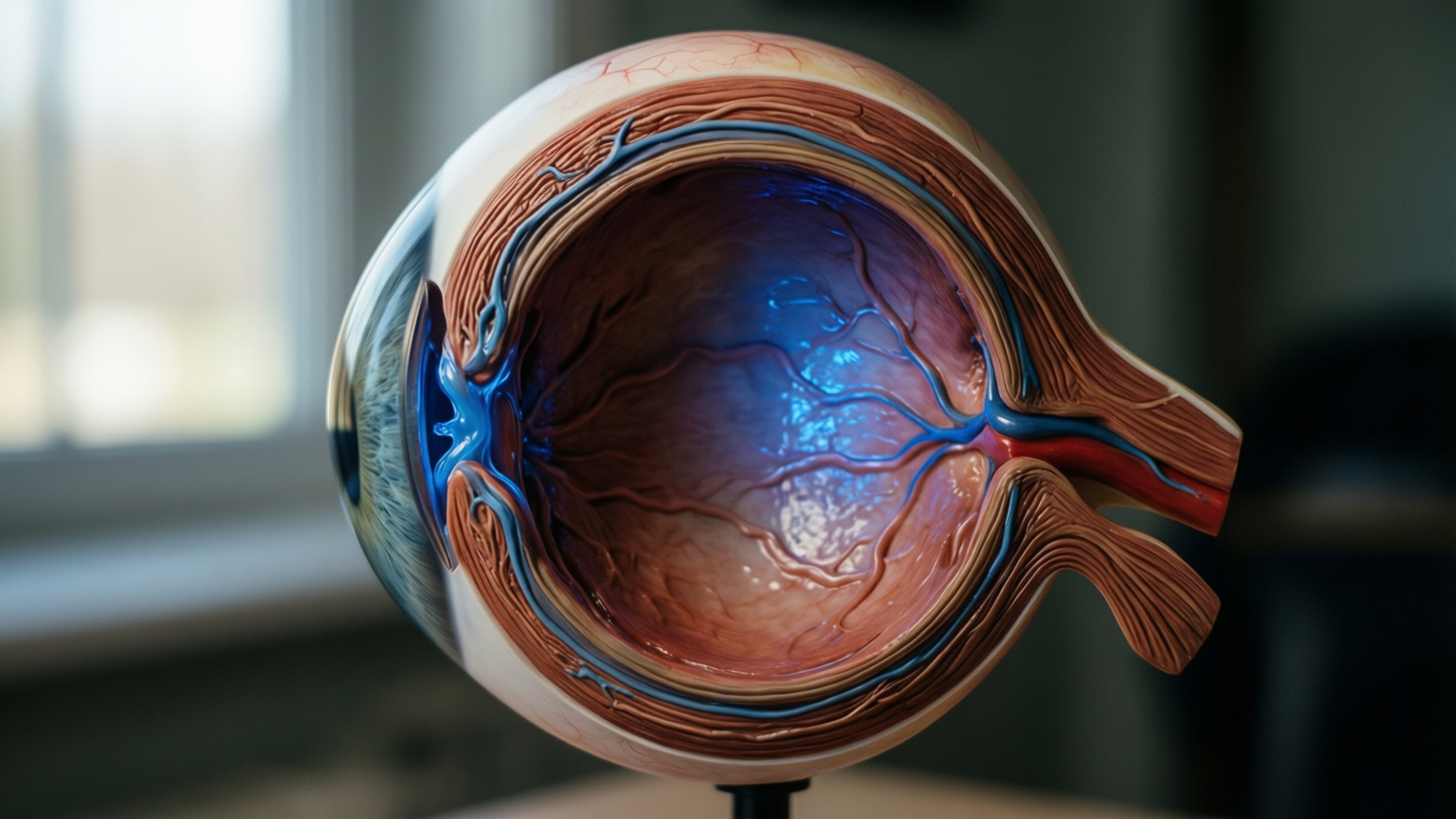
Scientists have identified a previously unknown drainage route at the back of the eye, revealing a hidden system that allows fluid and waste to escape into the body’s lymphatic network. The discovery challenges long-standing assumptions about how the eye functions and could eventually lead to new approaches for treating serious conditions that cause blindness.
Glaucoma, age-related macular degeneration, and several other major causes of permanent vision loss are associated with the accumulation of fluid, metabolic waste, and inflammatory material in the back of the eye. Until now, researchers have struggled to explain exactly how this sensitive region removes unwanted substances.
The POLO Pathway in the Choroid
A team from the University of British Columbia (UBC) and the University of Toronto has identified a previously unrecognized drainage route called the posterior ocular lymphatic outflow, or POLO pathway. The system appears to carry fluid and waste away from the back of the eye and into the lymphatic network, which helps the body maintain fluid balance, remove waste, and support immune defenses.
The finding, demonstrated in mice, offers scientists a new way to investigate how the eye protects its delicate tissues and what happens when waste removal is disrupted. The researchers placed fluorescent tracer molecules into a narrow space at the rear of the eye. Because these molecules could be detected as they moved, the scientists were able to follow the fluid’s path and determine where it traveled.
The results revealed tiny lymphatic vessels in the choroid, a thin, blood vessel-rich layer located beneath the retina. The choroid plays an important role in nourishing the outer retina, but lymphatic vessels had not previously been established in this region. The team observed fluid moving from the back of the eye into the surrounding orbital tissues, which occupy the space around the eyeball. Within minutes, the tracers reached nearby lymph nodes, connecting the eye’s newly identified drainage route to the body’s broader lymphatic system.
Challenging a Century of Assumptions
For over 100 years, scientists generally believed that the eye lacked the lymphatic drainage systems found in nearly every other organ. The lymphatic system consists of vessels and tissues that collect excess fluid, transport certain waste products, and help coordinate immune responses. It works alongside the blood circulatory system to maintain healthy conditions throughout the body.
The idea that the eye was largely separate from this network began to change in 2009, when Dr. Gupta and Dr. Yeni Yücel identified a lymphatic-related drainage route in the front of the eye. They named it the “uveolymphatic” pathway, providing evidence that the eye had previously unrecognized connections to the body’s fluid clearance mechanisms.
Dr. Yücel, a professor and director of ophthalmic pathology at the University of Toronto, continued investigating the possibility that similar pathways might exist elsewhere in the eye. Despite that earlier discovery, the back of the eye remained relatively unexplored. This was a particularly important gap because the retina and surrounding tissues are affected by some of the most serious diseases responsible for permanent vision loss.
“Because lymphatic vessels in the choroid were thought not to exist, the team used multiple techniques to demonstrate both their presence and function,” said Dr. Yücel, a pathologist-scientist at St. Michael’s Hospital. “We were surprised to see such a direct route for fluid to leave the eye and connect with the lymphatic system. It suggests the back of the eye has an active clearance pathway, which could play an important role in removing fluid, proteins and inflammatory material that build up in disease.”
Implications for Vision Loss Treatments
The retina is one of the most metabolically active parts of the body, constantly generating byproducts that need to be cleared. This discovery helps explain how the eye flushes this waste and promises to transform how we think about and treat a range of eye conditions.
Age-related macular degeneration alone affects approximately 2.5 million Canadians, highlighting the potential importance of understanding the processes that keep the retina healthy. The newly identified POLO pathway suggests that the back of the eye has a natural mechanism for moving unwanted material out of this vulnerable region. If scientists can determine how that mechanism works and whether it can be strengthened, it could provide a new target for therapies designed to protect vision.
“This gives us a whole new framework for understanding these diseases and a potential target for therapeutics,” said Dr. Neeru Gupta, professor and head of UBC’s department of ophthalmology and visual sciences. “The question now is: How can we enhance or exploit this cleanup system to treat or even prevent disease.”
Although the discovery offers a new explanation for how fluid and waste may leave the back of the eye, important questions remain. The experiments were conducted in mice, and further studies are necessary to establish how the POLO pathway functions in humans. Researchers also need to determine whether changes in this drainage system contribute to eye disease and whether its activity can be safely modified.
If those questions can be answered, the pathway could eventually offer several possibilities for treatment. One approach might involve developing therapies that improve fluid clearance, potentially reducing the buildup of substances associated with inflammation and tissue damage. Another possibility is using knowledge of this drainage route to improve how medications are delivered to structures deep within the eye. The findings were published in the scientific journal Translational Vision Science & Technology.
Source: ScienceDaily
