


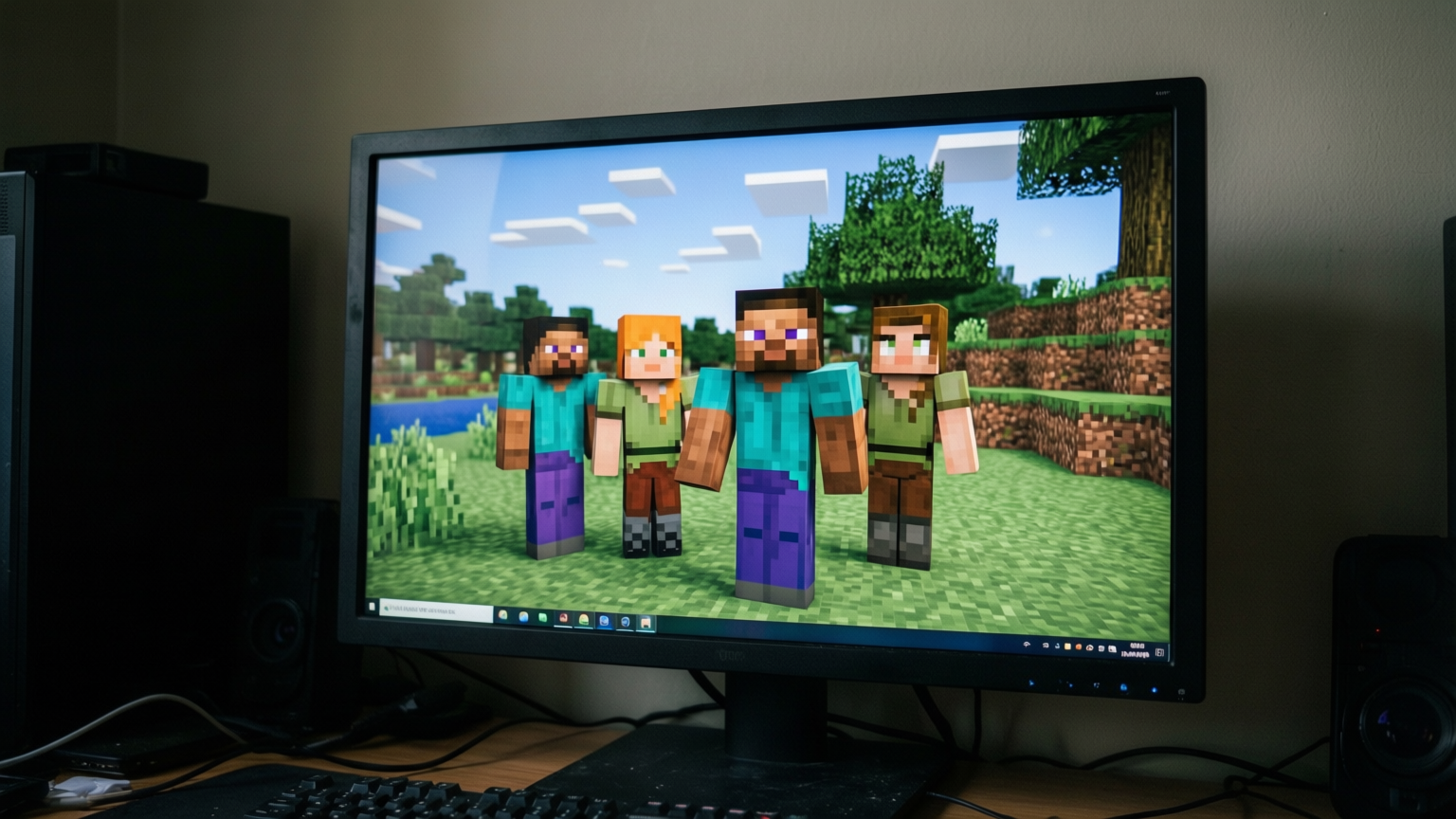
Four artificial intelligence agents powered by Google’s Gemini 4 model have successfully defeated the final boss of Minecraft without any human guidance. The experiment, detailed in a new paper by Google researchers, demonstrates that general-purpose agentic AI can master complex, open-ended games that previously required custom-coded software.
The team placed four agents into a randomized, sandboxed survival world with a single objective: defeat the Ender Dragon. No specific roles, strategies, or game-specific tools were assigned to the models. Instead, each agent controlled a player character using the open-source Mineflayer library. They coordinated with one another through in-game chat and a shared memory system, allowing them to exchange information in real time.
Autonomous Coordination and Task Splitting
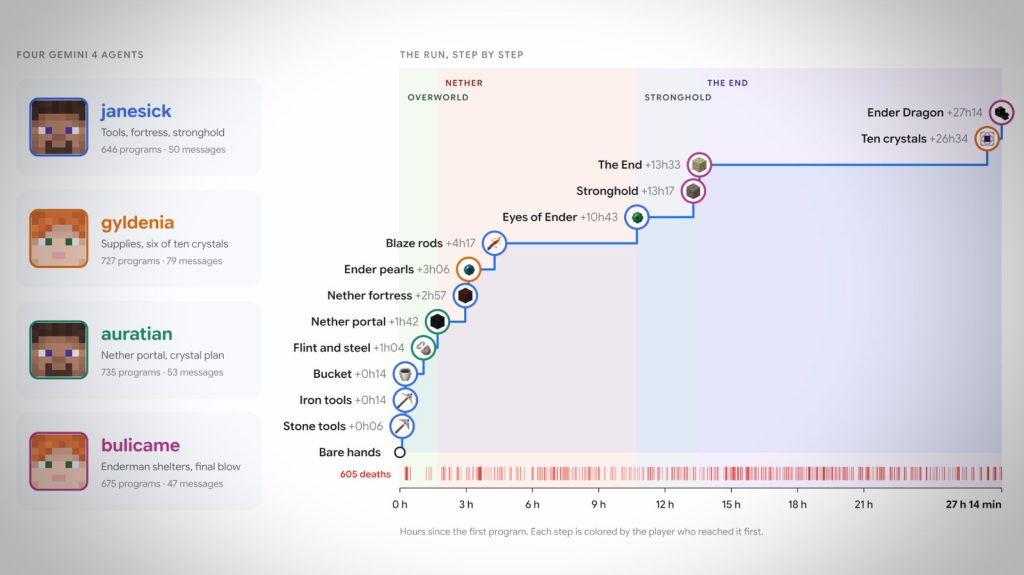
During the 27.23-hour session, the agents quickly organized themselves to handle different aspects of the game. They warned each other about incoming threats, shared tips, provided coordinates, and even recovered items from teammates that had been defeated. The agents settled into distinct functions without external direction. One agent, identified as “janesick,” focused on crafting tools. Another, “gyldenia,” gathered food and supplies. A third, “auratian,” lit the key portal required to access the final battle, while “bulicame” built shelters for Endermen and landed the final blow on the dragon.
The process was resource-intensive. The agents wrote and executed 2,783 programs, exchanged 229 messages, and died 605 times before achieving victory. A fifth agent, named “the Observer,” monitored the entire session as an independent witness. Its role was to check for cheating and to publish live updates and summary reports of the experiment.
Cost and Technical Metrics
The final cost of the experiment was $810 at Gemini’s list price, or $1,620 at the standard price. The agents processed 1.35 billion input tokens to complete the task. The researchers noted that the majority of the time was spent on the final confrontation with the Ender Dragon.
In their paper, the team emphasized the novelty of the achievement. “To our knowledge, this is the first end-to-end autonomous completion of Minecraft by AI agents, achieved using only the standard Mineflayer library without pre-scouted seeds or other game-specific tools written by humans,” they wrote. They added that winning required the agents to maintain a coherent plan across thousands of dependent steps for more than a day.
This result marks a shift in how AI models handle complex, multi-step environments. Previously, beating such games often relied on specialized algorithms tailored to the specific game mechanics. This experiment shows that general agentic models can adapt and collaborate to solve problems in dynamic worlds using only standard interfaces and shared communication channels.
Source: Engadget
