


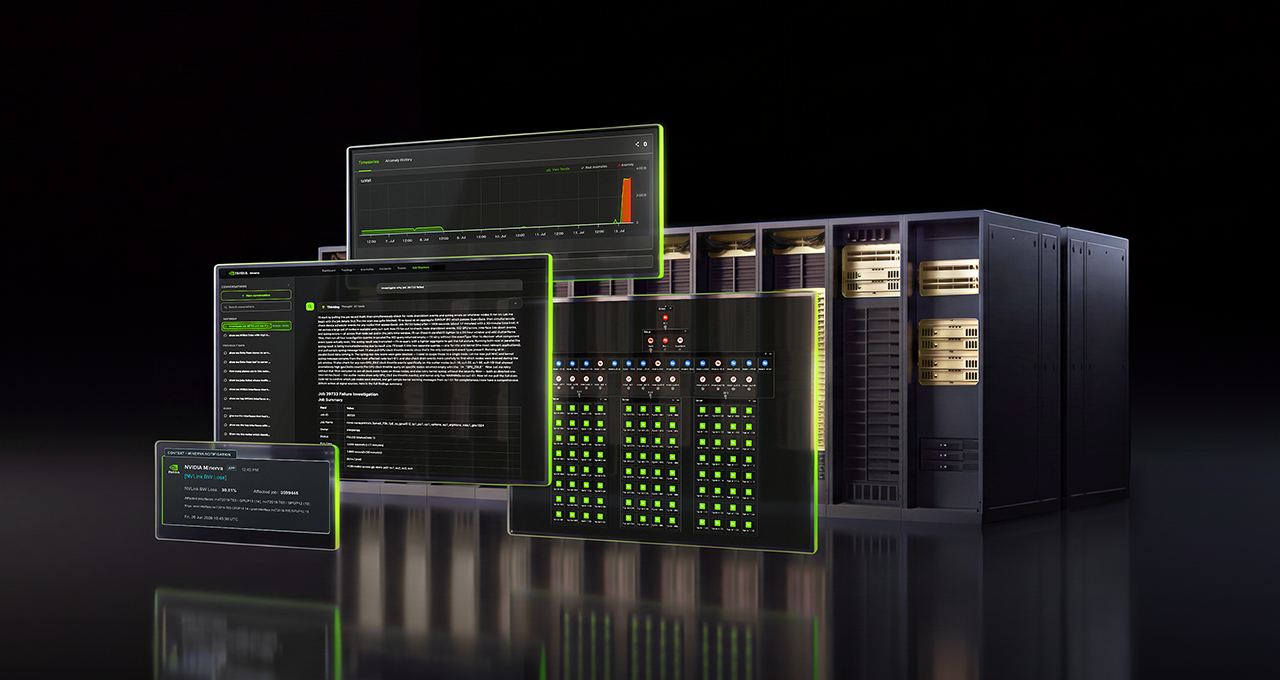
NVIDIA has launched Minerva, an AIOps platform designed to help engineering teams identify infrastructure issues earlier and maintain high productivity in large-scale AI operations. The system aggregates telemetry from both the underlying hardware and the AI workloads running on it, using specialized machine learning models to convert that data into actionable insights.
AI factories represent some of the most complex computing environments in existence. They rely on vast arrays of GPUs connected by high-speed networks to train models and serve applications. At this scale, a single degraded component, such as a GPU running hotter than its peers or an NVMe drive losing performance, can slow down an entire training job. These warning signs are often difficult to spot in traditional monitoring setups.
Unified Infrastructure Visibility
The platform focuses on AI factory yield, which measures the useful work infrastructure produces through GPU hours, goodput, cluster uptime, and token production. Traditional monitoring tools typically divide the data center into separate views, leaving networking, compute, site reliability, and machine learning teams looking at different parts of the operation.
Minerva connects these signals across NVIDIA GPUs, networking equipment, storage systems, schedulers, and workloads. It builds a dynamic knowledge graph that logically maps the infrastructure, including GPUs, SuperNICs, switches, and cables, along with the jobs running on them. This context allows operators to trace a slow training job back to the specific component affecting it, even in factories with hundreds of thousands of GPUs.
The system analyzes billions of data points per hour using supervised and unsupervised machine learning. It learns normal behavior patterns, detects previously unseen anomalies, predicts emerging failures, and correlates related events based on the factory’s topology. Instead of sending every symptom to an operator, it groups an event storm into a focused incident with a likely root cause.
Agentic AI and Partner Deployment
Minerva includes a native AI assistant and connects to external agentic AI tools. This provides a natural-language interface grounded in live telemetry. Operators can investigate cluster health and receive recommended remediation steps through conversation. Teams can keep a person in the loop to manually implement fixes or connect Minerva to automation through infrastructure application programming interfaces and external systems.
The ability to correlate workload and infrastructure issues, combined with agentic AI capabilities, helps simplify AI factory operations. By aggregating related problems into a single actionable item, the platform allows AIOps teams to move from reactive troubleshooting to proactive maintenance. This shift helps AI factories maximize GPU uptime and operational efficiency.
IREN is among the NVIDIA partners using Minerva to optimize its AI factories. Denis Skrinnikoff, chief technology officer of IREN, stated that maximizing GPU productivity is key to providing the best service for customers. He noted that Minerva gives the operations team one view across the network, the GPUs, and the jobs running on them, allowing the team to focus more on proactive maintenance rather than troubleshooting.
Several other major organizations plan to deploy Minerva, including Aolani, Bitdeer AI, IBM, Jio, Lambda, Quake AI, and Tesla. In addition to these software and service providers, Dell Technologies, Lenovo, and Supermicro will offer Minerva as part of their AI factory operations portfolios.
Source: NVIDIA
