


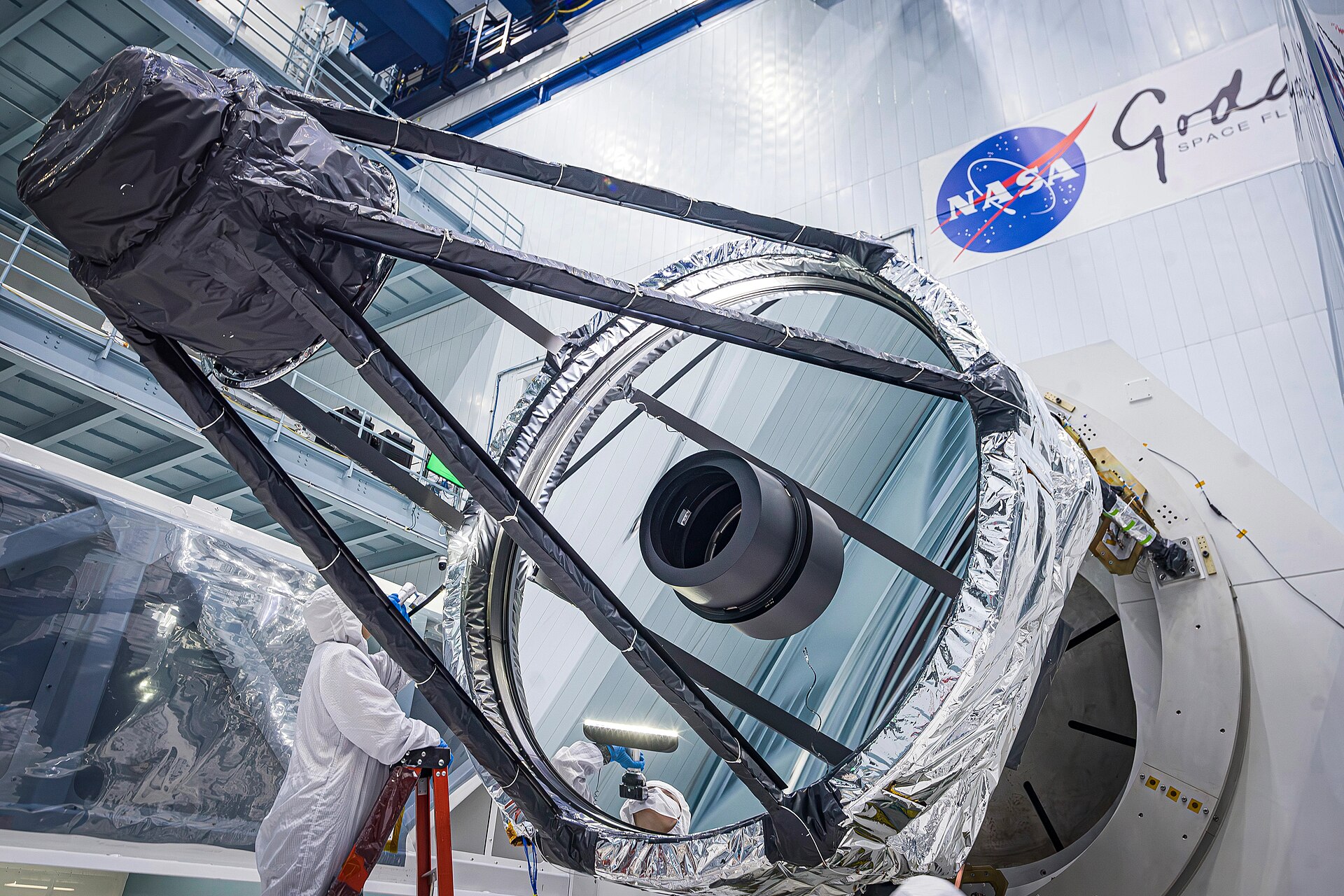
Engineers at NASA have completed an extensive series of tests and precision adjustments on the Nancy Grace Roman Space Telescope, resulting in performance that significantly exceeds initial projections. The observatory’s primary camera system, known as the Wide Field Instrument, is now delivering image quality nearly 30% better than scientists had anticipated before launch.
This achievement marks a critical milestone for the mission, which aims to investigate the nature of dark matter and dark energy. The improved optical precision allows the telescope to capture sharper images during its planned sweeping surveys of the cosmos, providing clearer data for researchers studying the universe’s hidden structures.
Wide Field Instrument Calibration
Following the activation of the Wide Field Instrument in September, a dedicated team of engineers launched a comprehensive testing campaign. Their primary objective was to verify that every component functioned correctly both independently and as part of the integrated system.
The testing process began with the instrument’s 18 detectors, each approximately the size of a standard sticky note, along with the associated electronics. The team then evaluated the element wheel, a rotating mechanism equipped with various filters and optical components. These elements allow specific wavelengths of light to reach the detectors and can separate incoming light into its individual colors for detailed analysis.
Engineers also activated the instrument’s internal calibration system, which uses light-emitting diodes as adjustable light sources. By measuring how the detectors respond to these controlled signals, scientists can identify sensitivity differences and apply necessary corrections for accurate observations.
The alignment mechanism was moved from the deliberately unfocused position used during launch to the position expected to provide the sharpest images. The team concluded the instrument-specific tests by checking the thermal control system, which maintains the precise temperatures required for the components to function correctly in space.
“All of Roman’s sweeping surveys will rely on the Wide Field Instrument,” said Dave Hickey, a systems engineer at NASA’s Goddard Space Flight Center. “Many of the mission’s primary goals, like studying dark matter and dark energy, wouldn’t be possible without it, so it’s both exciting and a huge relief to see that it’s working well.”
Optical Alignment and Precision
While one group focused on the Wide Field Instrument, another team worked to refine the telescope’s overall optical alignment. The results were encouraging from the start, as the mirrors and other optical components were already positioned with remarkable accuracy. This meant engineers needed to make only minor corrections to bring everything into near-perfect alignment.
Matthew Bolcar, Roman’s optical systems lead at NASA Goddard, noted that the telescope’s performance was excellent even before the alignment adjustments. He attributed this to exceptional preparatory work done on the ground prior to launch, involving extensive testing and modeling by Goddard and contractors.
Achieving this level of precision is particularly challenging for a spacecraft. The forces experienced during launch can cause tiny shifts in sensitive equipment, and conditions in orbit differ significantly from those on Earth. Despite these challenges, the recent assessments showed that ground testing was highly effective.
The team initially concentrated on the Coronagraph Instrument, which had been producing images that were slightly out of focus. The issue was less severe than anticipated, allowing engineers to correct it relatively easily. The coronagraph now meets the team’s demanding performance expectations, and engineers will continue refining its camera settings and deformable mirrors.
The final measurements for the Wide Field Instrument revealed an optical error of just 63 nanometers RMS, substantially better than the original requirement of approximately 90 nanometers. To put that scale into perspective, 90 nanometers is roughly 1,000 times thinner than a human hair.
Alden Jurling, a senior optical engineer at NASA Goddard, explained the magnitude of the adjustments. “We moved the secondary mirror by about one-sixteenth of the diameter of a human hair,” Jurling said. “If we scale that height up to the height of the Empire State Building, the change in height is a little bit less than you would get by stacking a single U.S. penny on top of the tower.”
With both scientific instruments meeting or surpassing their expected performance, the Roman Space Telescope has cleared another important milestone in its preparation for routine observations. The results highlight the extraordinary precision of the telescope’s design and offer a promising outlook for its upcoming investigations into the evolution of the universe.
Source: ScienceDaily
