


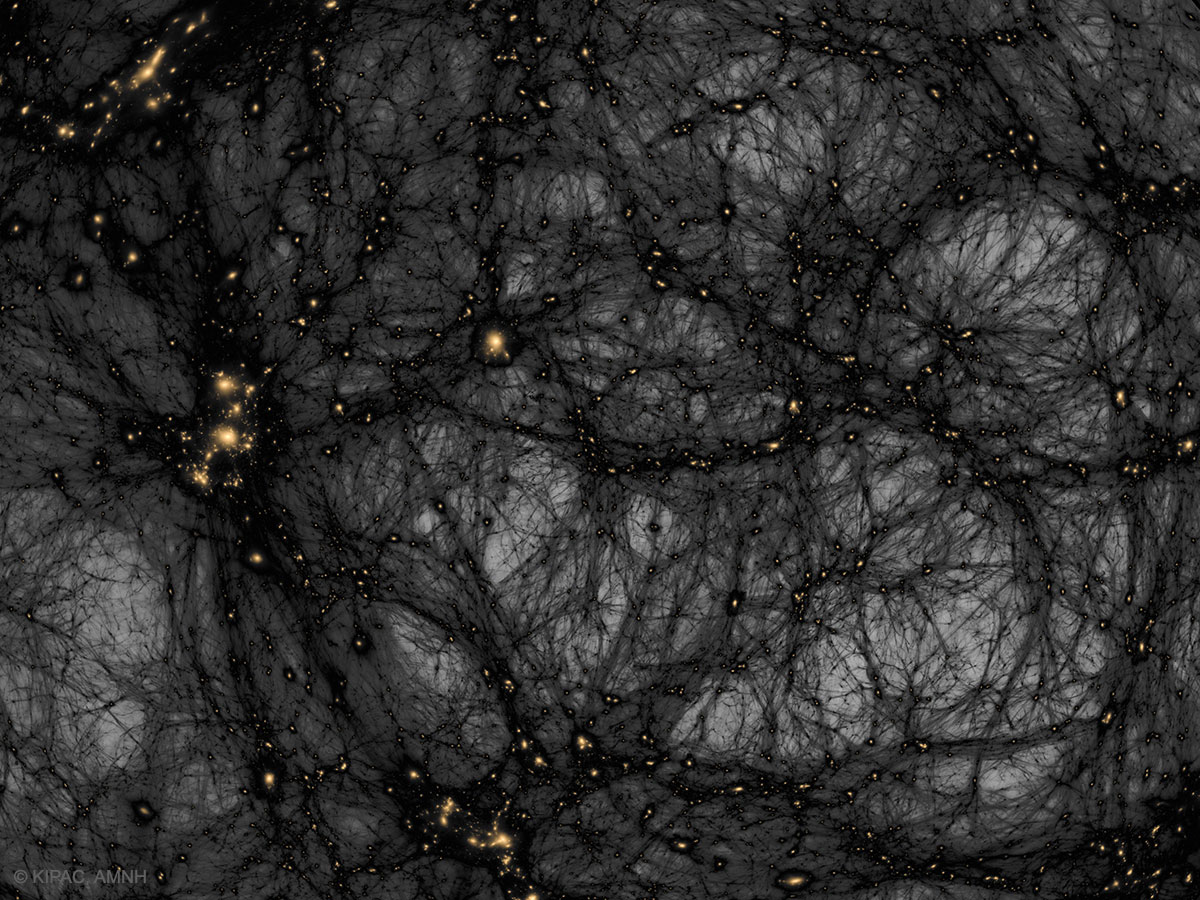
Astronomers continue to rely on computer models to understand the invisible structures that shape the cosmos. A recent visualization from the American Museum of Natural History’s Hayden Planetarium offers a detailed look at how dark matter might be distributed throughout the universe. The image, part of the Space Show titled “Dark Universe,” uses a dark matter simulation to illustrate the complex web of gravity that holds galaxies together.
Visualizing the Invisible Web
The featured image displays a frame from a high-resolution computer simulation. In this view, dark matter appears as black, complex filaments that stretch across the frame like a spider web. These structures represent the gravitational scaffolding of the universe. Scattered among these filaments are clumps of baryonic matter, shown in orange. These clumps represent the familiar visible matter that makes up stars, planets, and gas clouds.
According to the Hayden Planetarium, these simulations provide a statistical match to actual astronomical observations. The distribution of matter in the simulation aligns with data collected from telescopes, confirming that dark matter plays a central role in how galaxies form and evolve. The gravity of this unseen material is the leading explanation for why galaxies rotate at high speeds and why they orbit clusters so rapidly.
Dark Energy Takes Center Stage
While dark matter provides the gravitational glue that binds structures together, a different force is driving the universe apart. The explanation for the image notes that dark matter is no longer considered the strangest source of gravity in the cosmos. That distinction now belongs to dark energy.
Dark energy is described as a more uniform source of repulsive gravity. It appears to dominate the expansion of the entire universe, pushing galaxies away from each other at an accelerating rate. This repulsive force contrasts sharply with the attractive pull of dark matter. Together, these two mysterious components dictate the large-scale structure and future of the universe.
The visualization serves as a reminder of how much remains unknown about the cosmos. Although dark matter and dark energy cannot be seen directly, their effects are evident in the motion of stars and the expansion of space. The Hayden Planetarium’s “Dark Universe” show aims to help the public grasp these abstract concepts through clear, data-driven imagery.
The image is part of a daily series of astronomical photographs and explanations. The next entry in the series will feature Orion the Great, continuing the exploration of our night sky.
Source: NASA
