


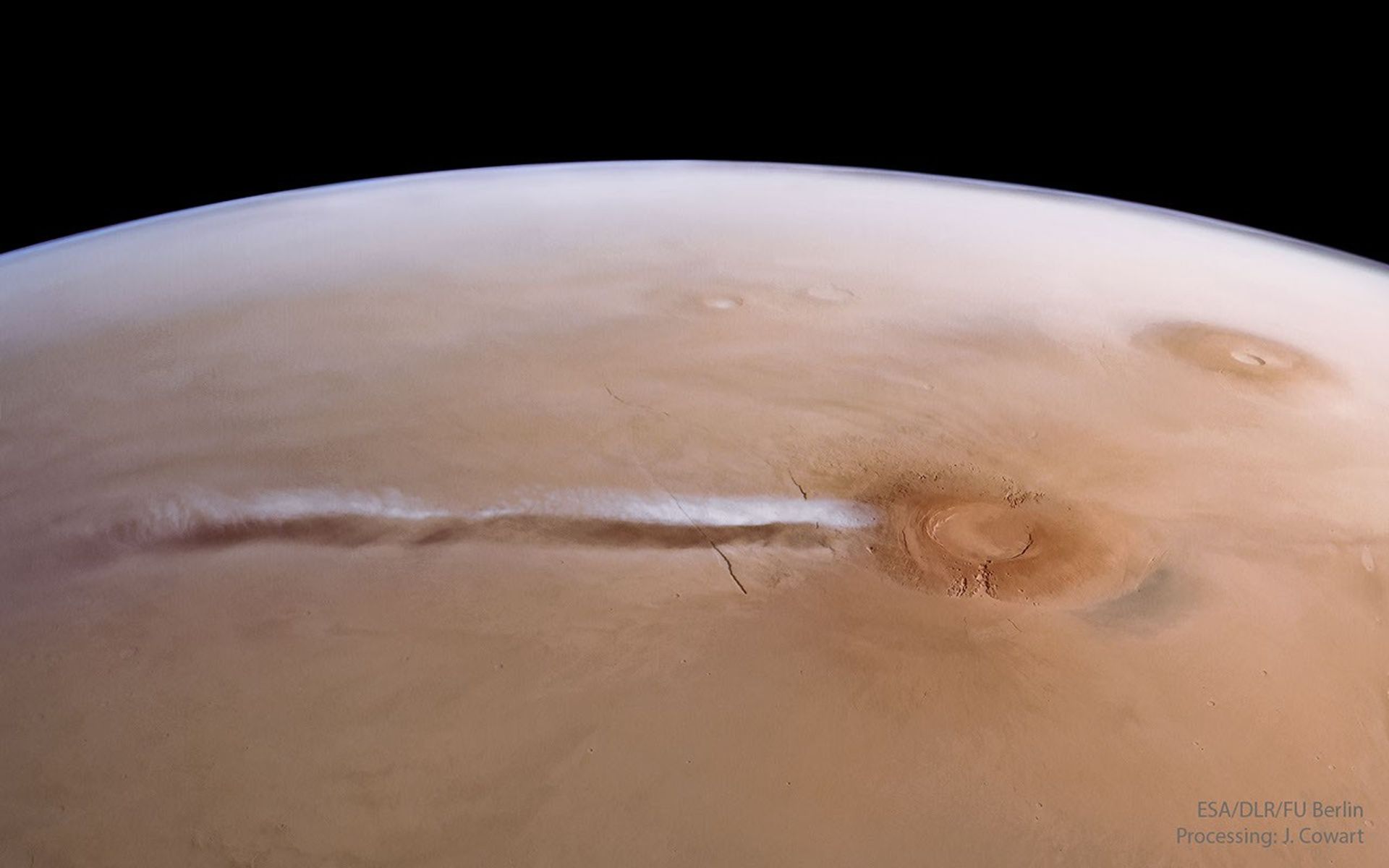
A rare and unusually long cloud hovering over Mars has long puzzled scientists. Known as the Arsia Mons Elongated Cloud, or AMEC, this atmospheric phenomenon stretches for thousands of kilometers across the planet. While the cloud was first recorded by NASA’s Viking Orbiter 2 in 1977, recent high-resolution images from ESA’s Mars Express spacecraft have provided clearer details about its structure and behavior.
Historical Observations and Modern Imaging
The AMEC was initially detected during the early era of robotic planetary exploration. Viking Orbiter 2 captured the first images of the cloud in 1977, marking it as a persistent feature of the Martian atmosphere. For decades, the cloud remained a subject of interest due to its unusual shape and longevity. More recently, the Mars Express spacecraft, operated by the European Space Agency, has imaged the cloud in greater detail. The featured image used in recent studies was captured by Mars Express in 2018, offering a modern perspective on a phenomenon observed nearly 40 years prior.
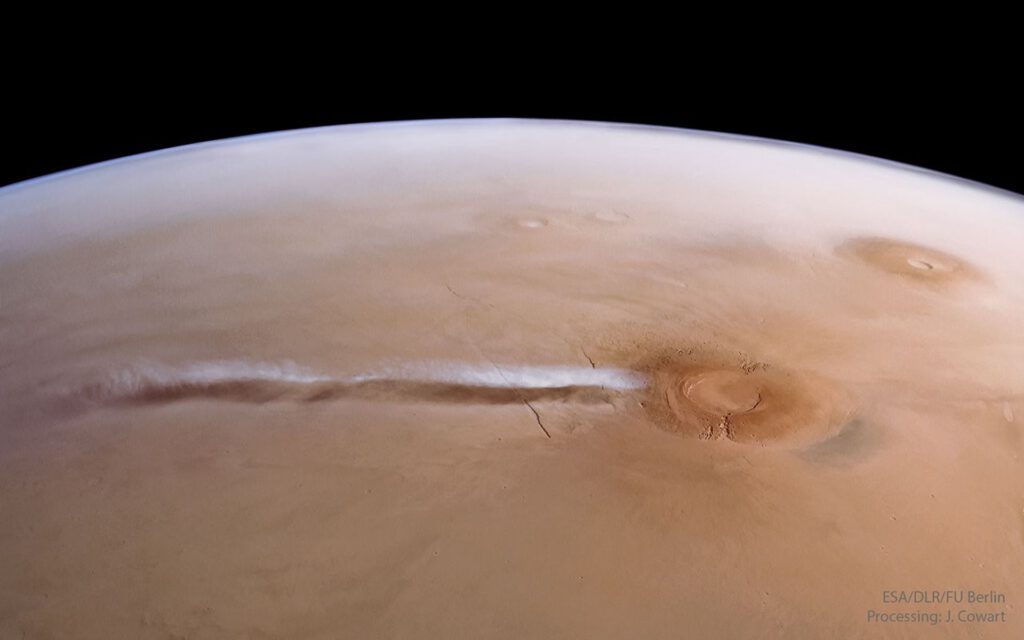
These observations have helped researchers understand the specific conditions required for the cloud to form. The AMEC appears only during the spring and summer seasons on Mars. Furthermore, it is a morning phenomenon, developing and dissipating within specific daily windows. This strict timing suggests a delicate balance of atmospheric temperature and wind patterns that allows the cloud to persist.
Formation Without Dust
The composition and formation process of the Arsia Mons Elongated Cloud differ significantly from typical clouds on Earth. The cloud is made of water-ice crystals. On Earth, cloud formation usually relies on dust particles acting as nuclei for ice crystals to form around. However, the Martian atmosphere is extremely thin and lacks sufficient dust at the high altitudes where the AMEC forms. This absence of dust means the standard cloud formation process fails in this environment.
Leading speculation among scientists is that dust is not involved in the creation of the AMEC. Instead, the cloud forms near the volcano Arsia Mons. Once the ice crystals coalesce, strong winds blow the cloud downstream from the volcano. This wind action creates a long tail that can extend over 1500 kilometers. The result is a striking, elongated shape that stands out against the Martian landscape.
Understanding the mechanics of the Arsia Mons Elongated Cloud provides valuable insights into Martian meteorology. The unique conditions that allow water-ice clouds to form without dust nuclei are distinct from those on Earth. Continued study of these clouds may help bolster a more complete view of cloud formation processes on our own planet. Researchers are committed to further analyzing data from both Viking and Mars Express missions to unravel the remaining mysteries of this atmospheric oddity.
Source: NASA
