


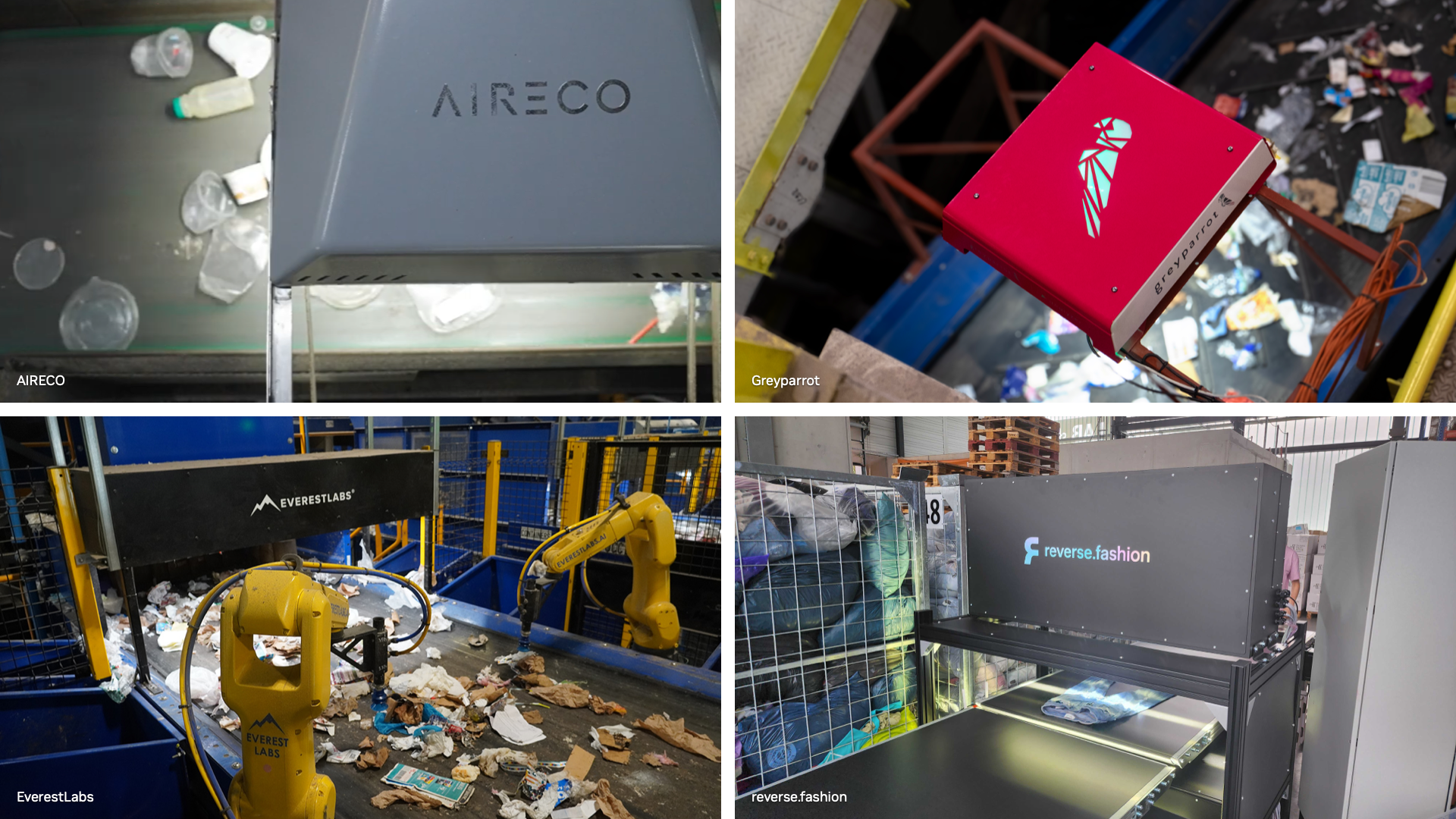
As world leaders convene for COP31 in Türkiye, the push for a zero-waste future faces a stark reality: less than 7% of materials entering the global economy come from recycled or reused sources. Municipal solid waste generation currently exceeds 2 billion tons annually and is projected to nearly double by 2050. To reverse this trajectory, a wave of AI recycling startups is deploying computer vision and robotics to automate sorting, recover valuable resources, and keep materials in circulation.
Finer Sorting for Closed-Loop Plastic Recycling
Recycled plastic often fails to compete with new material due to inconsistent quality and reliance on manual labor. AIRECO, a Taiwan-based startup, addresses this by using vision AI to sort plastics with high precision. This allows materials to be separated from mixed scrap piles for closed-loop recycling, where used items are reprocessed into new versions of the same product.
Chun-Feng Liu, founder and CEO of AIRECO, emphasized the importance of precision. He stated that finer sorting increases the likelihood that an item, such as a plastic bottle, can be recycled back into a bottle repeatedly rather than being downcycled into low-grade products that are difficult to recycle further.
The company utilizes NVIDIA Jetson Orin NX modules to run inference on its pilot line at a recycling plant in Tainan. These modules drive robotic arms that pick targets off a conveyor belt, achieving recognition accuracy above 95%. AIRECO plans to expand to a full production line next year, aiming to triple annual waste processing capacity from 18,000 to 48,000 tons while cutting operating costs by 85%.
Real-Time Sorting at Material Recovery Facilities
At material recovery facilities, sorting must occur in real time on fast-moving conveyor belts. EverestLabs AI, a U.S. startup, has deployed about 150 computer vision-guided robots across facilities in North America and Australia. The system runs AI inference on NVIDIA RTX GPUs at the edge, with models trained on NVIDIA data center GPUs and optimized using NVIDIA CUDA.
R. Paul Singh, CEO of EverestLabs AI, noted that unlike other robots, their systems must act quickly before materials move down the line. The company estimates its deployed systems have identified approximately 40 billion objects, recycled roughly 25,000 tons of material, and avoided about 30,000 metric tons of carbon dioxide emissions. The team is also shipping agentic AI tools to provide actionable data to facility staff and executives.
U.K. startup Greyparrot offers a different approach with its Analyzer platform. Mounted above conveyor belts, the system uses computer vision to identify each passing object by material and brand, even in dusty environments or poor lighting. Greyparrot uses NVIDIA GPUs to train models on billions of objects, while NVIDIA Jetson modules handle rapid detection at the edge.
Ambarish Mitra, cofounder of Greyparrot, explained that waste composition shifts constantly, making manual sampling unreliable. The Analyzer system has made over a trillion bounding box detections across more than 300 units in over 20 countries. This technology reduces the time needed to check 15 tons of waste from 375 hours to just six. Facilities using the real-time data report efficiency gains of 10% to 30%, with global packaging company Amcor seeing a 12% increase in the yield of food-grade plastics.
Automating Textile Sorting in Europe
Europe generates nearly 7 million tons of used textiles annually, with about a quarter collected separately. Sorting is traditionally slow, costly, and hard to staff. reverse.fashion, a Berlin-based startup, automates this process using high-resolution computer vision to identify product type, defects, color, size, brand, fabric construction, season, and style.
Karsten Pufahl, cofounder and chief technology officer of reverse.fashion, noted that AI models for textiles must run at very high resolution because humans are picky about quality. The system analyzes each textile as it moves across a conveyor belt at 3 meters a second, passing through over a dozen vision AI models optimized with NVIDIA TensorRT software and running on NVIDIA Jetson modules.
The system sorts in an hour what previously took a week. reverse.fashion is currently rolling out its technology to facilities in Europe, aiming to unlock the value of reusable garments that would otherwise be downcycled or landfilled.
Source: NVIDIA
