


Organizations are finding it difficult to turn early artificial intelligence wins into widespread business results, according to a new study commissioned by Microsoft and conducted by IDC. While two-thirds of leaders report substantial results from AI initiatives, only 48% are successfully scaling that value across multiple business units.
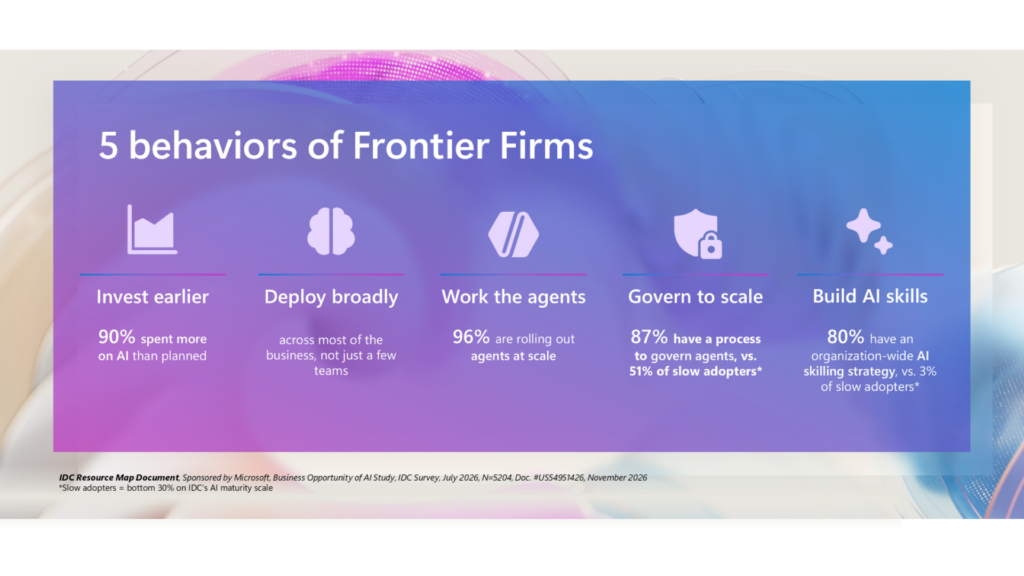
The research, which surveyed more than 5,200 senior IT and business leaders across 28 industries, identifies a specific group of high performers called “Frontier Firms.” These organizations represent the top 10% on IDC’s AI maturity scale. They distinguish themselves by managing AI investments, models, agents, governance, and skills as a single, accountable discipline rather than isolated technology projects.

Frontier Firms Lead in Agent Adoption
The gap between early adopters and those scaling value is most visible in the use of AI agents. Currently, 36% of organizations are still piloting these autonomous tools. In contrast, Frontier Firms have moved beyond experimentation. They report a 3.8x return on investment for agents, compared to a 3.0x return for slower adopters.
At Bristol Myers Squibb, an AI agent named RABIT connects information across meetings to help teams make better decisions. Lakshman Yerramalla, Director of Portfolio Governance and Delivery for Global Manufacturing Operations, noted that the tool reduces administrative follow-up work. Project managers using the agent save an estimated 20% of their time.
These leaders are not just spending more money. They are redesigning work processes around AI. The biggest opportunity identified is freeing employees for higher-value tasks. Leaders point to creativity, innovation, and business reinvention as the primary areas where AI allows people to focus more, alongside customer-facing work and data interpretation.

Governance and Skills Close the Confidence Gap
Trust in AI systems is high, but confidence in managing security and governance risks lags behind. Most leaders report high trust in their AI systems, yet fewer are highly confident in addressing security risks. As agents take on more work, governance must extend beyond model performance to ensure human oversight.
Conagra Brands made governance its starting point. Tracy Schaefer, Chief Information Officer, explained that the company built a steering committee to review risk factors, access, and identity management before engaging employees with AI tools. This foundation allowed them to introduce responsible AI practices safely.

Workforce confidence is running ahead of the plans to support it. Skills remain the widest gap in this year’s research. Black & Veatch reached 98% adoption of Microsoft 365 Copilot through deliberate change management. They used early-adopter cohorts to surface real business use cases. Mike Adams, Chief Digital Technology Officer, stated that their goal is to be a Frontier Firm, with the intention to go beyond pure adoption.
Treating AI as Business Transformation
Organizations scaling fastest treat AI as a change in how the business runs, not a technology rollout. Eric Tabor, Chief Digital Officer at KOHLER, emphasized that many companies miss the mark on business skilling. He noted that his company focuses on dissecting processes and converting them into AI workflows.
When choosing an AI platform, 44% of leaders cite trust and security as top criteria, tied with leading-edge technology and model performance. The right model must be matched to each job, balancing cost with the protection of intellectual property and data.

With 71% of organizations expecting AI budgets to rise by 10% or more in the next 12 months, this discipline will separate leaders from the rest. The full InfoBrief will follow, and regional infographics are available for Europe, Asia Pacific, and the Americas.
Source: Microsoft
