


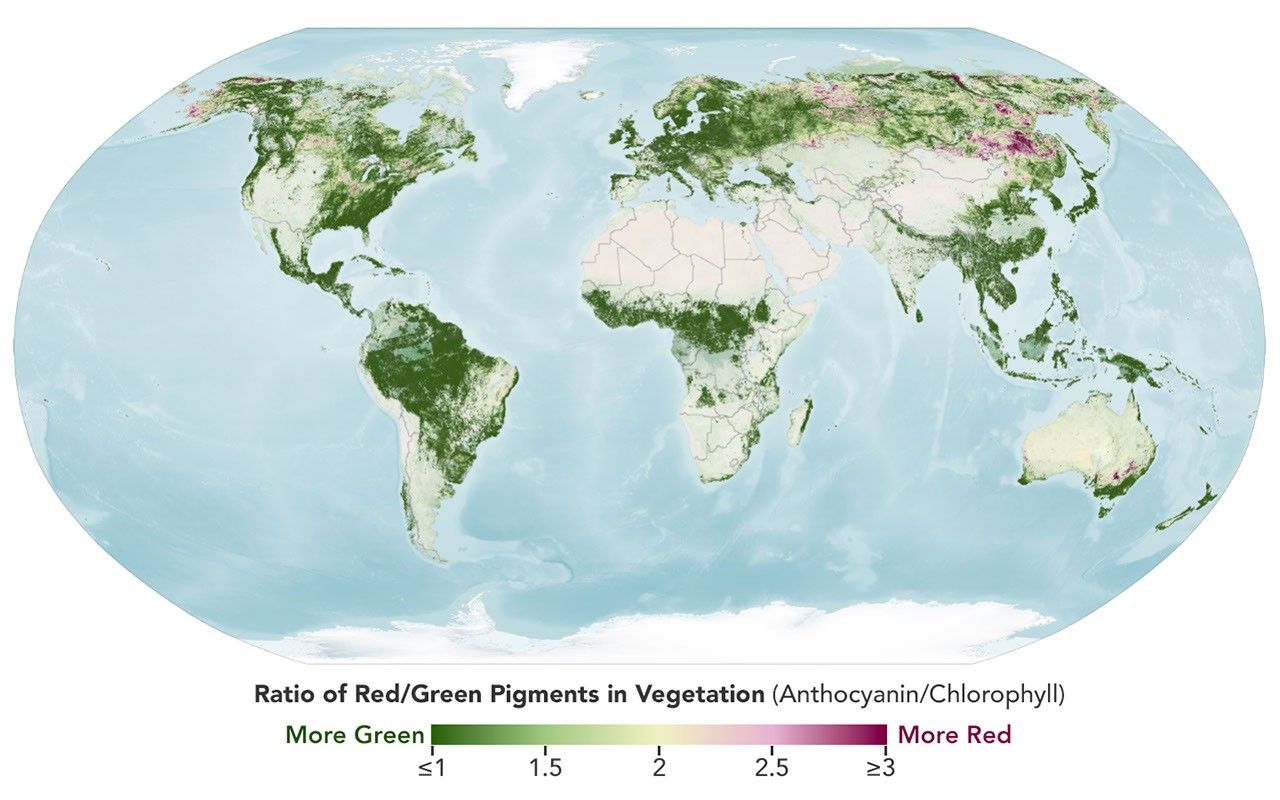
A modern satellite is transforming the ancient tradition of leaf-peeping into a data-driven science. The Ocean Color Instrument (OCI) aboard NASA’s PACE (Plankton, Aerosol, Cloud, ocean Ecosystem) satellite now observes the planet’s vegetation daily across 286 spectral bands. This technology allows scientists to monitor subtle shifts in leaf pigments that drive autumn color displays, moving beyond simple visual observation to precise chemical tracking.
Tracking Pigments Across Continents
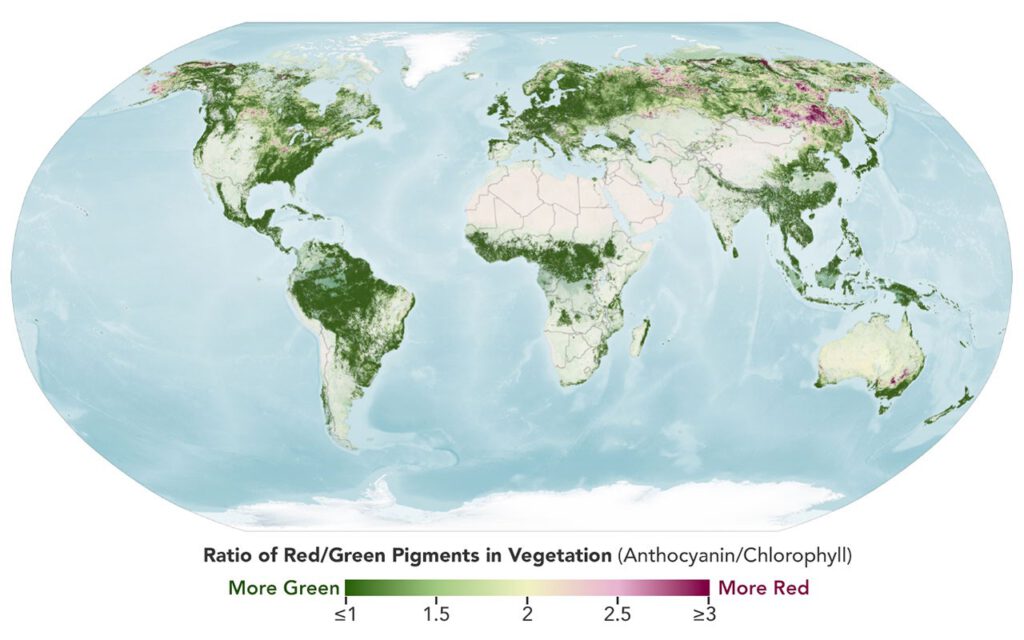
The OCI measures the ratio of red, orange, and yellow pigments against green chlorophyll to determine when and where leaves are changing. These maps reveal the progression of fall color from high latitudes toward the equator. Data from late September and early October showed intense redness in northern Russia, northern Alaska, and northern Canada. As the season progressed into the week of October 5 to 11, redness began to fade in New England and upstate New York while spreading across the Midwest and Mid-Atlantic.
Scientists attribute the intense reds in regions like the Adirondacks, the Green Mountains in Vermont, and the White Mountains in New Hampshire to sugar maples and red maples. In marshy tundra areas, blueberries, bilberries, sedges, mosses, and grasses likely contribute to the detected colors. The satellite distinguishes between these natural displays and other phenomena, such as high anthocyanin levels in aging crops or cloud cover gaps.
Leaf color changes occur as plants lose chlorophyll, the green molecule essential for synthesizing food. Chlorophyll production requires sunlight and warm temperatures. As autumn brings shorter days and cooler temperatures, chlorophyll levels drop, allowing carotenoids and anthocyanins to become visible. The PACE satellite is the first capable of measuring all three key pigments globally every day or two, a capability that previous hyperspectral sensors lacked due to their localized and infrequent coverage.
Ripton, Vermont, and the Frost Connection
While satellite data provides a broad view, ground-level imagery captures specific moments of peak color. The Operational Land Imager on Landsat 9 captured an image of intensely red foliage around Ripton, Vermont, on October 3, 2026. This location holds historical significance for autumn literature, as poet Robert Frost kept a summer home and farm there and taught at Middlebury’s Bread Loaf School of English. Frost authored several poems that evoke fall foliage, including “October,” “The Road Not Taken,” and “Nothing Gold Can Stay.” The Landsat image documents the peak of redness in this specific region, offering a concrete visual anchor to the broader satellite data.
Karl Huemmrich, a vegetation scientist with the Goddard Earth Sciences Technology and Research II center at the University of Maryland, Baltimore County, emphasized the value of this continuous monitoring. Huemmrich, a member of the PACE science team, noted that the ability to collect time-series data of anthocyanins and carotenoids everywhere on Earth repeatedly is transformative. This data allows researchers to determine peak redness and yellowness anywhere on the planet.
Ground Truthing and Future Research
NASA data scientist Skye Caplan has been posting weekly foliage maps as part of the North American Phenology Campaign, run by the Global Learning and Observations to Benefit the Environment (GLOBE) program. These maps show waves of red emerging in August and shifting southward. The PACE team is asking the public to submit photos of fall foliage to help scientists “ground truth” the satellite observations. This public participation helps clarify how various factors influence vegetation color.
Caplan noted that pigment changes can also result from vegetation stress due to drought or insect damage. This likely explains why PACE measures high levels of redness in agricultural regions of Brazil, Australia, and Canada that do not align with broader seasonal changes. Ground photos help scientists refine these observations, supporting research into how the timing of spring greening and fall senescence is changing, how vegetation changes affect the global carbon cycle, and how leaf color influences wildfire risk.
Scientists also aim to determine if PACE can detect early warning signs of drought, insect infestations, and plant disease. The GLOBE campaign welcomes observations of shrubs, grasses, wildflowers, evergreens, and crops, not just dense forests. Caplan advised that people should not delay in submitting photos, as color changes happen slowly, then all at once, and then disappear.
Source: NASA
