


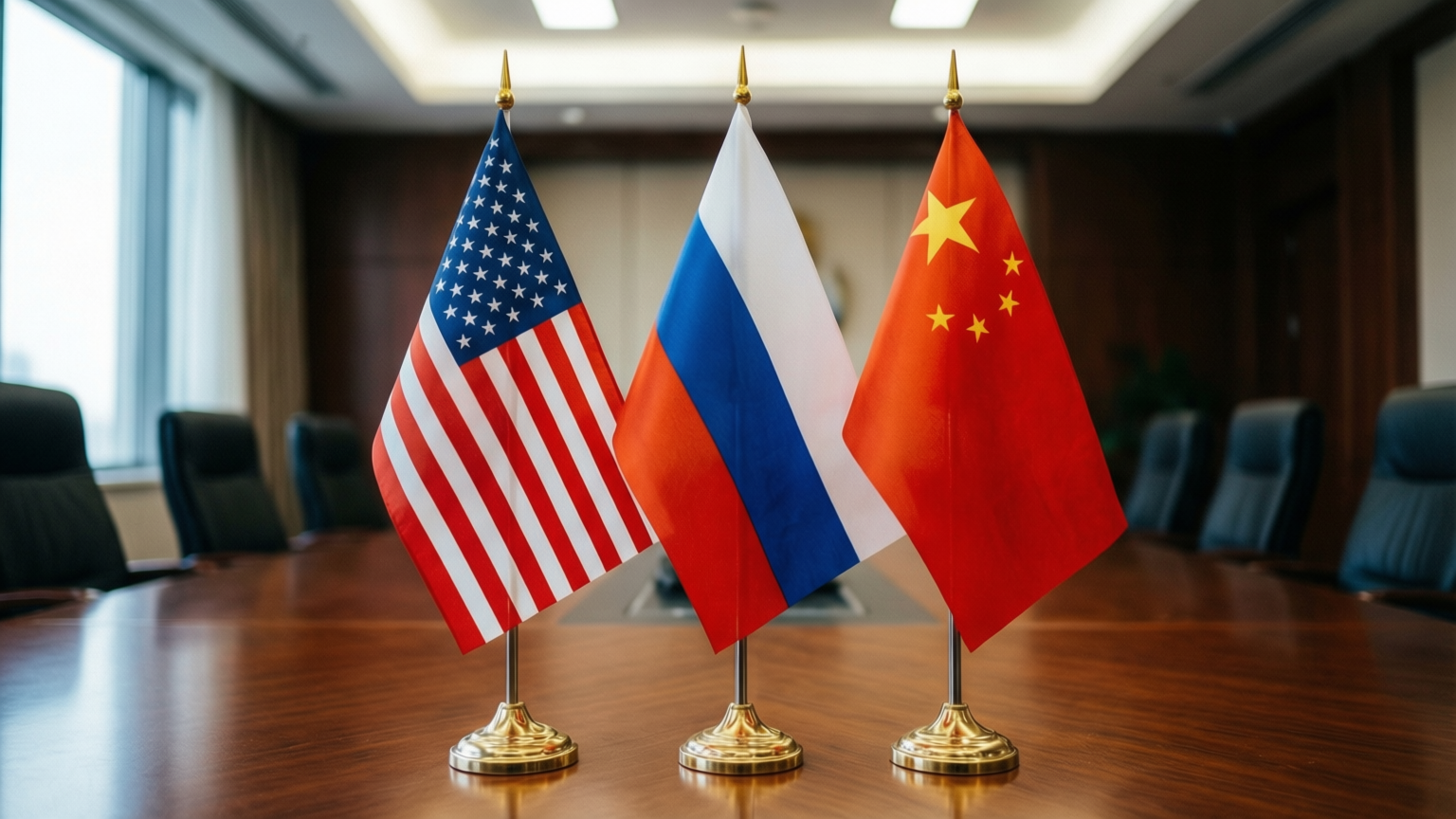
US President Donald Trump, Russian President Vladimir Putin, and Chinese President Xi Jinping have issued a joint declaration of peace following historic trilateral talks in Shenzhen, China. The three leaders met for 90 minutes on the sidelines of the Asia-Pacific Economic Cooperation (APEC) summit, marking the first time all three have engaged in a single multilateral discussion.
Key points of the peace declaration
The statement released after the closed-door session at the Kylin Villa resort emphasized that nuclear war cannot be won and must never be fought. The leaders also agreed to increase the production and supply of petroleum and expressed a commitment to reform the United Nations to better address global challenges.
Additionally, the declaration addressed the jurisdiction of international legal bodies. The presidents agreed that the International Criminal Court and similar institutions must not abuse their authority over state officials.
Trump described the meeting as a “great and highly consequential trip” in a social media post while flying back to Washington. He announced plans to host a news conference at the White House to discuss the outcomes of the summit.
Divergent goals on Ukraine and energy
While the joint statement highlighted shared interests, the leaders entered the talks with different priorities. Xi Jinping opened the session by stating that positive interaction among major powers is a mandatory requirement. Putin highlighted a shared interest in ending the war in Ukraine and discussed food and energy security.
China has maintained official neutrality since Russia launched its full-scale invasion of Ukraine in 2022. Beijing has called for negotiations while avoiding direct condemnation of Moscow. Trump stated that the three nations have a special responsibility to maintain dialogue and reduce nuclear weapons globally.
Putin told reporters after the meeting that Ukraine and Europe are not yet ready to make compromises to resolve the conflict. He noted that Russia has invited EU representatives to Moscow to understand their position better. The Kremlin leader also vowed a painful retaliation for recent Ukrainian attacks on the bridge connecting Russia to the occupied Crimean peninsula.
Reactions from Washington and Moscow
US lawmakers expressed mixed reactions to the summit. Republican Senator John Curtis welcomed the commitment to preventing nuclear war but warned against treating Putin and Xi as friends. He argued that such an approach risks undermining national security and trust with allies.
Democratic Senator Jeanne Shaheen offered a harsher critique, calling Putin a war criminal. Meanwhile, the Kremlin described the meeting as an important chapter in diplomatic history. Russian state media reported that Xi called the talks positive and constructive, recalling the history of fighting side-by-side during World War II.
The summit marked the first time since the start of the war in Ukraine that Putin participated in an international gathering with leaders from countries including Canada, Japan, and Australia. Some Russian newspapers labeled the event a diplomatic victory after years of Western isolation.
Source: BBC
