


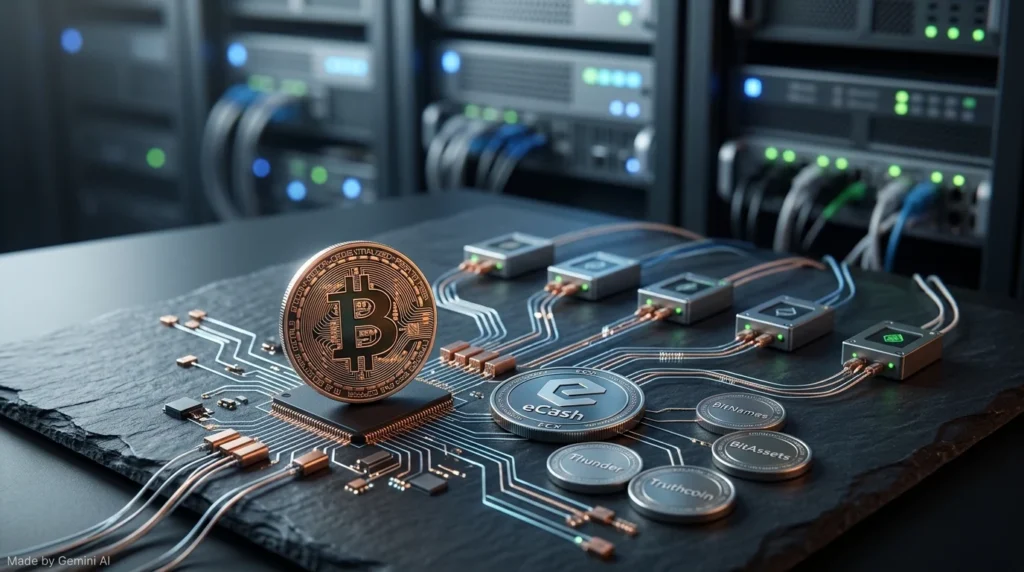
The eCash mainnet launch marks the immediate activation of five Bitcoin sidechains, introducing a modular architecture that allows for diverse applications without altering the base Bitcoin protocol. The newly live networks include BitNames for digital identity, BitAssets for tokenized assets, Thunder for accelerated payments, Truthcoin for prediction markets, and zSide for privacy-centric transactions.
Two additional networks, Photon and CoinShift, remain in active development. Photon is designed to be quantum-resistant, while CoinShift functions as a decentralized exchange. This expansion follows a phased testing period where community participants drove initial network activity, with alpha hashrate peaking at 9.44 PH/s across seven independent mining pools.
Drivechain Architecture and Security
Bitcoin’s base layer prioritizes security and decentralization, often limiting programmability. This constraint has historically pushed scaling experiments, smart contracts, and privacy protocols to other chains like Ethereum. The Drivechain model offers an alternative by allowing sidechains to inherit Bitcoin’s proof-of-work security through merged mining while maintaining independent rule sets.
Assets can move between the eCash mainchain and its sidechains, creating a flexible ecosystem. This approach avoids the need for consensus changes to Bitcoin Core itself. Paul Sztorc, chief executive of LayerTwo Labs and the original author of the BIP 300/301 proposals, emphasized the structural benefits of this setup.
“eCash provides the competitive testing ground necessary to safely drive financial infrastructure forward without risking the core network,” Sztorc said. “After ten years of development, we are finally unlocking a free market, where builders can experiment without permission, users can choose which innovations have value, and the market decides what succeeds.”
ECX Token Distribution and Regulatory Landscape
As part of the eCash mainnet launch, all Bitcoin holders at the fork snapshot receive ECX at a 1:1 ratio. Users with self-custody wallets can separate their BTC and ECX holdings using coin-splitting tools available in the eCash mobile wallet. This distribution method mirrors previous hard forks but introduces specific regulatory considerations.
Regulatory bodies are closely monitoring hard forks and airdrop mechanics. In the UK, HM Revenue and Customs treats forked coins received by existing holders as potentially taxable at the point of receipt. Other jurisdictions handle these events differently, creating a complex compliance landscape for exchanges.
Exchanges that list ECX must evaluate whether the 1:1 airdrop triggers compliance obligations for their users. This is particularly relevant under the EU’s Markets in Crypto-Assets Regulation, which came into full effect in 2024 and imposes strict disclosure requirements on crypto-asset issuers.
Market Reception and Future Indicators
The Drivechain model has circulated in Bitcoin developer discussions for nearly a decade, attracting both support and skepticism. Critics within the Bitcoin Core community argue that merged-mined sidechains introduce miner-extractable risks to the base layer. Proponents contend that opt-in sidechains impose no cost on users who do not participate.
The shift from testnet to a live mainnet moves the debate from theoretical to empirical. The success of the five initial sidechains will depend on their ability to attract meaningful developer and user activity. Key indicators to watch include exchange listings for ECX, the speed of independent developer deployment, and whether institutional custody providers extend support to the new token.
These factors will largely determine whether the fork establishes a functional secondary market. The immediate availability of five distinct sidechains provides a concrete test case for the Drivechain protocol’s viability in a live economic environment.
Source: The Fintech Times
