


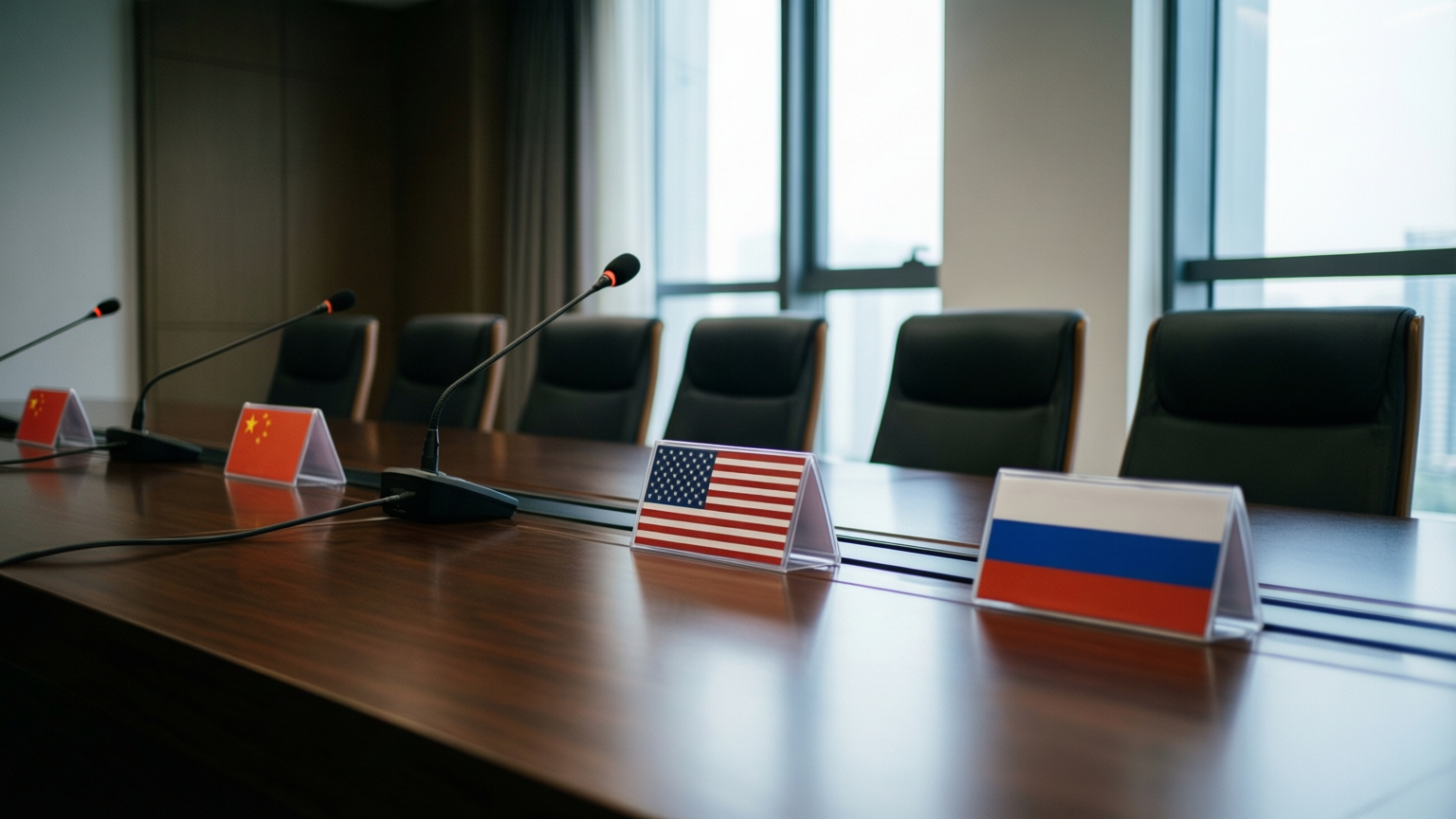
Before the first trilateral summit between Xi Jinping, Donald Trump, and Vladimir Putin convened in Shenzhen, observers predicted a new Yalta conference. They expected the three leaders to divide the world and dictate terms to smaller nations. When a reporter asked Putin about this scenario, he nodded. Xi urged the group to abandon Cold War thinking, stating that harmony among major powers ensures global peace.
The meeting produced the China-Russia-US Declaration toward Peace. It did not produce a carve-up of the globe. The summit revealed a stark contrast between the leaders. Two were trapped in unwinnable wars. The third, Xi, held the weight to change their odds but chose not to use it.
Trump and Putin’s Strategic Dilemmas
Trump arrived in Shenzhen facing domestic and international pressures. His party lost control of both chambers of Congress in recent midterm elections. He is also engaged in a conflict with Iran that has disrupted oil supplies and shipping through the Strait of Hormuz since February. By one account, he arrived seeking achievements rather than votes, with limited options left.
Putin came trailing a war in Ukraine that has lasted five years. His economy is losing momentum, and he remains isolated by Western sanctions. Ukraine was on the agenda at Trump’s initiative. However, American envoys Steve Witkoff and Jared Kushner traveled to Berlin to brief Ukrainian and European leaders first. President Volodymyr Zelenskyy insisted that issues concerning Ukraine must be decided with Ukraine.
Beijing’s position on Ukraine offers a different perspective. Chinese officials have suggested that had China armed Russia, the front lines would look different. Strategists describe China’s approach as constructive neutrality. They argue that siding openly would have widened the war. China’s red lines may have lowered nuclear tensions.
China’s Calculated Neutrality
While leaders met, fighting continued. Russian drones hit Kharkiv. Ukraine struck oil facilities in Tatarstan and damaged the Kerch Bridge. The war was being settled on the ground, not at a diplomatic table. This reality made a room in Shenzhen incapable of carving up the conflict.
China also refused to accept commitments on other powers’ terms regarding nuclear arms. Washington sought a trilateral framework involving Russia and China. Beijing declined to join on equal terms. Its arsenal of an estimated 620 warheads is a fraction of the roughly 5,000 held by the US and Russia. Beijing cites this disparity as a reason for refusing equal terms.
The final declaration covered UN reform, refined oil supply, and opposition to International Criminal Court jurisdiction abuses. It pledged that a nuclear war cannot be won. Critics called it the lowest common denominator. Beijing had managed to convene the other two powers on its own terms.
China now occupies a position similar to the United States before 1914 and 1939. Its restraint sets the terms more than its force. On purchasing-power terms, it is the largest economy. Its manufacturing base equals the G7 combined. Its military leads in a growing list of categories. China could alter the trajectory of the wars in Ukraine and the Middle East. Each runs through Beijing.
Beijing’s treatment of Trump was revealing. He was given center stage, including a tarmac welcome and a front-row seat at the group photograph. Commentators called it a host humbling a supplicant. It was the weakened guest who received the platform. Offering Trump dignity conserved Beijing’s leverage.
China faces vulnerabilities. It deals with a tightening security arc, a weak property market, youth unemployment, and military corruption. Its constructive posture reflects a judgment that exercising influence too freely would expose its limits. The smaller economies of the region benefit from this restraint. Their stability is a by-product of a balance they did not negotiate.
Xi expressed confidence that the seeds planted at the meeting would eventually bear fruit. It was a bet, not a result. The Yalta 2.0 label endures because it is a flattering story. The world in Shenzhen was not governed. It was balanced. Xi’s greatest power lies in the wars he has chosen not to enter.
Source: Al Jazeera
