

Close Menu
iM.NewsiM.News

    Subscribe to Updates

    Get the latest creative news from FooBar about art, design and business.

    What's Hot

    Bikers and Bug Lovers Unite to Block Google Data Center

    November 9, 2026

    Antarctic Ozone Hole Hits 7th Largest in 48 Years

    November 9, 2026

    British Airways 787 Stranded in Pittsburgh for 2 Months

    November 9, 2026
    Facebook X (Twitter) Instagram
    iM.NewsiM.News
    Subscribe
    • Home
    • Lifestyle

      Lagos Thrift Style to Chanel Runway: Rachel Ojuromi’s Journey

      November 9, 2026

      Miro1 Protein Identified as Key Driver of Type 2 Diabetes Insulin Resistance

      November 9, 2026

      Stroke Therapy Gap: Only 6.4% Get Recommended Care

      November 9, 2026

      The Guardian Sudoku 7516: Easy Puzzle for Monday

      November 9, 2026

      NHS Physiotherapy Maternity Cover Funding Gap

      November 8, 2026
    • Relations

      Trump Floats UFC Chief Dana White for Press Secretary, Then Retracts

      November 9, 2026

      Trump Defends Nvidia CEO Amid Spying Allegations

      November 9, 2026

      Rubio Cites Progress on Ukraine Security Guarantees Ahead of Abu Dhabi Talks

      November 9, 2026

      Merz to Nominate Aigner as Germany’s First Female President

      November 9, 2026

      Europe Joins U.S.-Brokered Ukraine Talks in Abu Dhabi

      November 8, 2026
    • Technology

      Bikers and Bug Lovers Unite to Block Google Data Center

      November 9, 2026

      NVIDIA Investigates CEO Jensen Huang Over Chinese Spy Claims

      November 9, 2026

      NVIDIA Partners With Samsung, Kakao, LG to Build Korea’s Physical AI

      November 9, 2026

      Nvidia CEO Jensen Huang Apologizes for Affair Amid Espionage Claims

      November 9, 2026

      Amazon Uber Eats Deal Sparks DoorDash Sell-Off

      November 9, 2026
    • Travel & Tourism

      British Airways 787 Stranded in Pittsburgh for 2 Months

      November 9, 2026

      American Airlines Refuses $650 Bump Promise, Cites Aircraft Swap

      November 9, 2026

      British Airways 777 Exceeds Speed Limit Amid Strong Jet Stream

      November 8, 2026

      Philippine Airlines Launches Nonstop Chicago Route

      November 8, 2026

      US Fines Air France and KLM for Low Flights Over Iraq

      November 8, 2026
    • Get in Touch
    iM.NewsiM.News
    Home»Features»Antarctic Ozone Hole Hits 7th Largest in 48 Years
    Features

    Antarctic Ozone Hole Hits 7th Largest in 48 Years

    im.newsBy im.newsNovember 9, 2026No Comments3 Mins Read0 Views
    Facebook Twitter Pinterest LinkedIn Tumblr Email
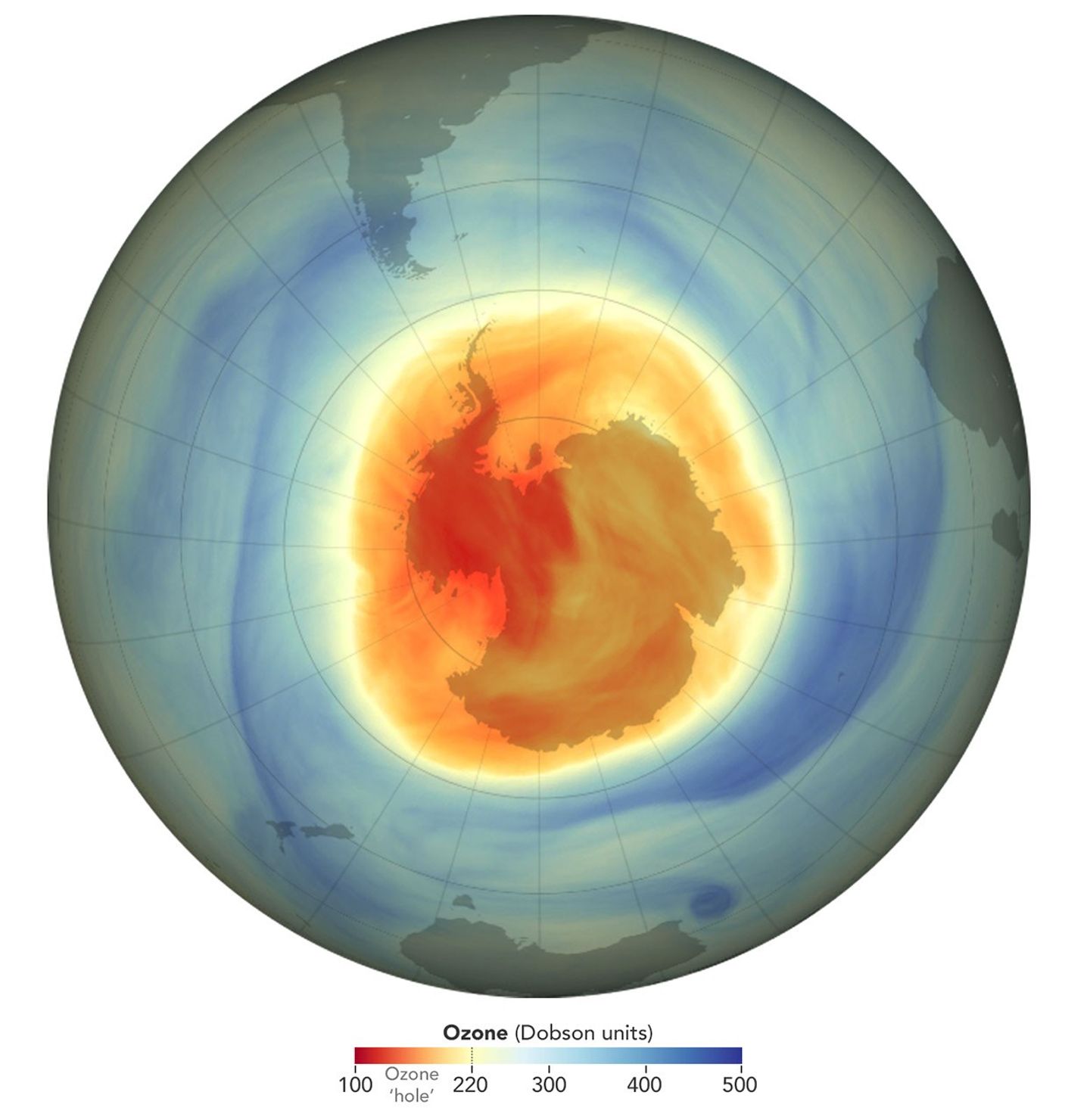
    Satellite map showing the 2026 ozone hole over Antarctica with red and yellow areas indicating low ozone concentrations
    Image: NASA
    Share
    Facebook Twitter LinkedIn Pinterest WhatsApp Email

    NASA satellite data confirms that the Antarctic ozone hole reached its maximum area on September 18, 2026. The event ranks as the seventh largest in 48 years of continuous monitoring, according to the National Aeronautics and Space Administration.

    While the spatial extent of the depletion was significant, the hole was not as deep as other major events recorded in the historical data. The measurement relies on a threshold of 220 Dobson Units (DU), a standard established to identify areas where ozone concentrations drop low enough to be classified as a hole.
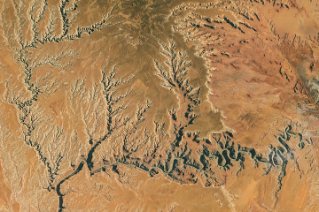
    A deep, narrow canyon with tight curves runs across the bottom through an orange desert landscape. Several wider, shallower canyons join up with the main channel.
    Image: NASA

    2026 Ozone Hole Size and Depth

    The size of the ozone hole fluctuates annually based on stratospheric temperature and circulation patterns. In 2026, an unusually strong Antarctic polar vortex created ideal conditions for ozone depletion over a large area. This meteorological setup allowed the hole to expand significantly during the peak depletion season, which runs from September 7 to October 13.

    Despite the large area, the concentration of ozone within the core did not fall as low as it did in some previous years. The deepest ozone hole on record occurred in 1994, when concentrations dropped to 73 DU. In contrast, the 2026 event, while extensive, maintained higher ozone levels in its center compared to those extreme historical lows.

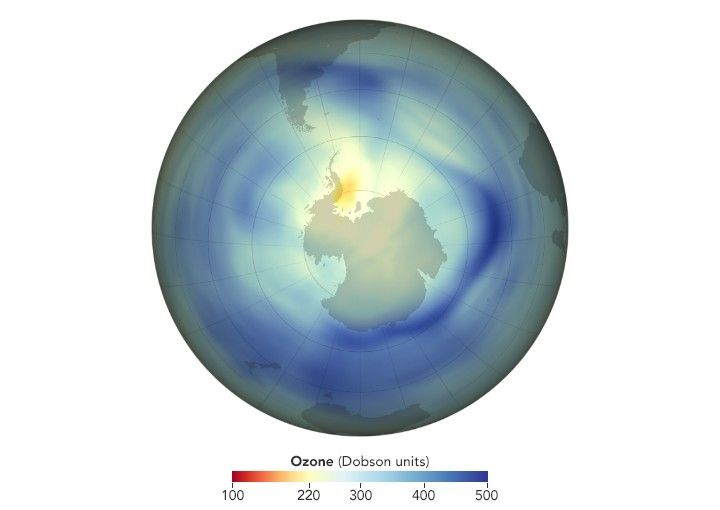
    Scientists use the term “hole” as a metaphor for the region where ozone levels are critically low. No area is completely empty of ozone. The data visualizations from NASA Earth Observatory show the state of the atmosphere on the day of maximum depth for each year from 1979 through 2026.
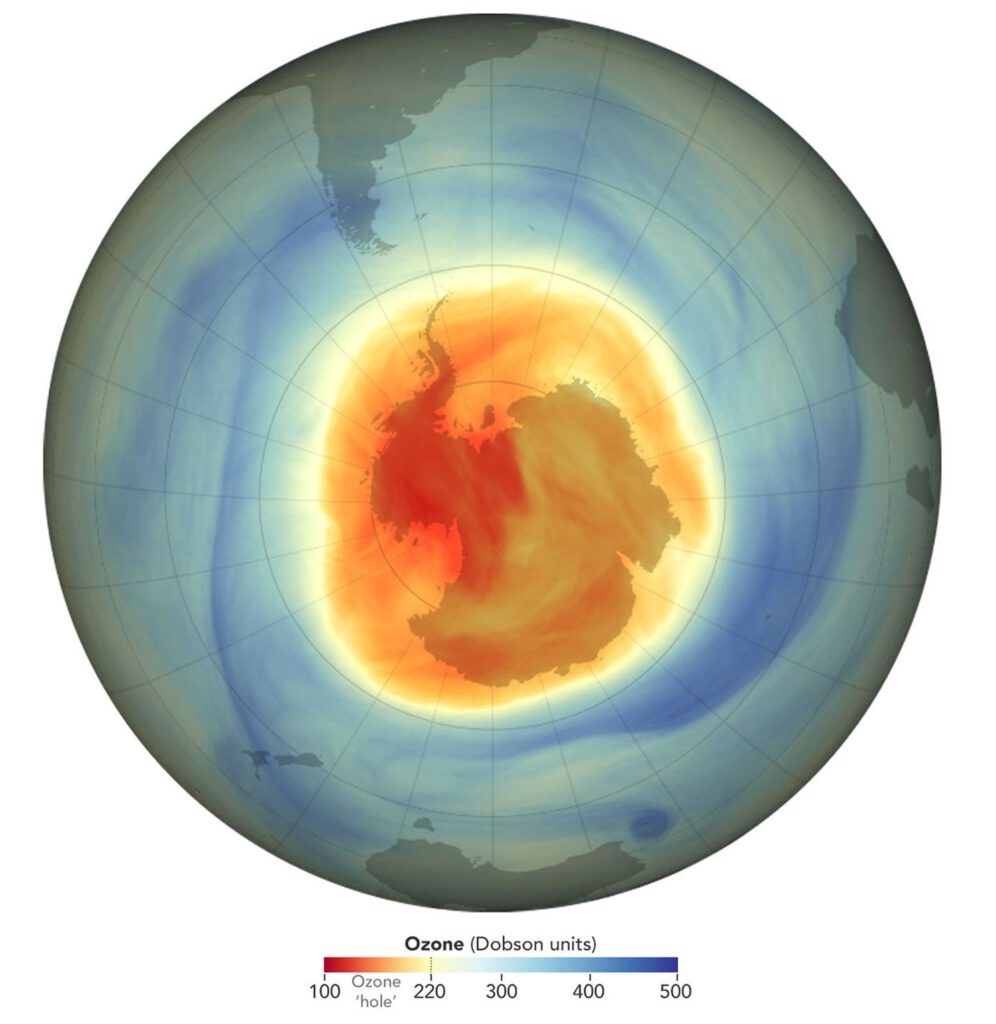
    A map centered on the South Pole shows ozone concentrations on September 18, 2026. Areas at and below 220 Dobson units, the threshold that defines the ozone hole, appear in yellow, orange, and red, and cover a roughly circular region over Antarctica and part of the Southern Ocean. Higher concentrations surrounding it appear in light to dark blue.
    Image: NASA

    Historical Context and Recovery Trends

    The monitoring of the Antarctic ozone layer began in 1979. For the first few years, the maximum depth of the hole remained in the 190s DU. However, the situation deteriorated rapidly in the early 1980s. By 1985, concentrations had fallen to 124 DU, and by 1991, they dropped below 100 DU for the first time.

    The discovery of this thinning was a pivotal moment in environmental science. British Antarctic Survey scientists first reported the dramatic thinning in 1985 using ground-based measurements. NASA satellites later revealed the continental scale of the phenomenon, confirming that human activity was driving the depletion.
    1979
    Image: NASA

    The primary driver of this depletion is chlorofluorocarbons (CFCs). These long-lived chemicals, used in refrigeration and aerosols since the 1930s, circulate in the lower atmosphere for decades. When they reach the stratosphere, ultraviolet light breaks them apart, releasing chlorine. This chlorine catalyzes the destruction of ozone molecules.

    The global response to this threat was the 1987 Montreal Protocol. This treaty phased out the production and consumption of ozone-depleting substances. Scientists estimate that approximately 80 percent of the chlorine currently in the stratosphere originates from human sources rather than natural ones.

    Recovery is a slow process. Models suggest that chlorine concentrations will not return to pre-1980 levels until later in the 21st century. In 2018, scientists reported the first direct satellite evidence of recovery, noting a 20 percent decrease in ozone depletion between 2005 and 2016. The Antarctic ozone layer is projected to return to 1980 levels in the 2070s.
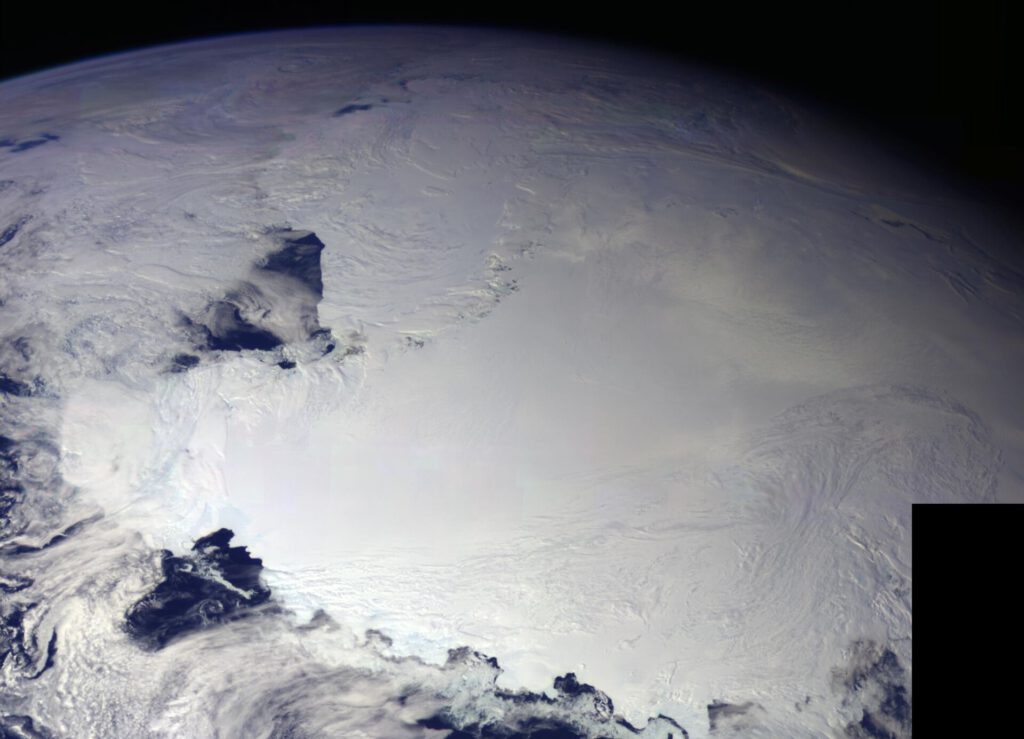
    Ross Ice Shelf, Antarctica on Earth
    Photo: NASA/JPL / Wikimedia Commons, Public domain

    The 2026 data continues to show the impact of weather variability on ozone levels. In 2019, abnormal weather patterns limited depletion, resulting in the smallest hole since 1982. The 2026 maximum demonstrates that while the long-term trend is toward recovery, annual conditions can still produce large holes.

    Source: NASA

    Antarctica climate science Environment Features NASA Ozone Hole
    Share. Facebook Twitter Pinterest LinkedIn Tumblr Email
    Previous ArticleBritish Airways 787 Stranded in Pittsburgh for 2 Months
    Next Article Bikers and Bug Lovers Unite to Block Google Data Center
    im.news

    Related Posts

    Bikers and Bug Lovers Unite to Block Google Data Center

    November 9, 2026

    British Airways 787 Stranded in Pittsburgh for 2 Months

    November 9, 2026

    NVIDIA Investigates CEO Jensen Huang Over Chinese Spy Claims

    November 9, 2026
    Leave A Reply Cancel Reply

    Latest Posts

    Bikers and Bug Lovers Unite to Block Google Data Center

    November 9, 20260 Views

    Antarctic Ozone Hole Hits 7th Largest in 48 Years

    November 9, 20260 Views

    British Airways 787 Stranded in Pittsburgh for 2 Months

    November 9, 20260 Views

    NVIDIA Investigates CEO Jensen Huang Over Chinese Spy Claims

    November 9, 20261 Views
    Stay In Touch
    • Facebook
    • Twitter
    • Pinterest
    • Instagram
    • YouTube
    • Vimeo
    Don't Miss

    Epstein List Phase 1: Full Flight Logs, Client List Released

    February 28, 2025 News Focus 243 Views

    In a stunning development that has sent shockwaves through political and entertainment circles, Attorney General…

    Microsoft Stock Joins Exclusive $4 Trillion Club After Blockbuster Cloud + AI Earnings

    July 31, 2025

    DOJ & FBI Find No Epstein Client List, Suicide Confirmed

    July 7, 2025

    Subscribe to Updates

    Get the latest creative news from SmartMag about art & design.

    About Us
    About Us

    We provide the daily life news. You find latest trendy news at our portal, from entertainment to economy or politics.

    We're accepting new partnerships right now.

    Email Us: info@im.news

    Facebook X (Twitter) RSS
    Our Picks

    Bikers and Bug Lovers Unite to Block Google Data Center

    November 9, 2026

    Antarctic Ozone Hole Hits 7th Largest in 48 Years

    November 9, 2026

    British Airways 787 Stranded in Pittsburgh for 2 Months

    November 9, 2026
    Most Popular

    Epstein List Phase 1: Full Flight Logs, Client List Released

    February 28, 2025243 Views

    Microsoft Stock Joins Exclusive $4 Trillion Club After Blockbuster Cloud + AI Earnings

    July 31, 2025193 Views

    DOJ & FBI Find No Epstein Client List, Suicide Confirmed

    July 7, 2025153 Views
    © 2026 I'm News. Designed by I'm News.
    • Home
    • Lifestyle
    • Relations
    • Travel & Tourism
    • Technology

    Type above and press Enter to search. Press Esc to cancel.