



Scientists at the European Organization for Nuclear Research, known as CERN, have recorded evidence of an extremely rare particle decay. This event, captured by the Large Hadron Collider (LHC), represents the first experimental step toward exploring the zeptoverse. This term refers to a scale of physical reality measured in zeptometers, which are quadrillionths of a meter. The discovery confirms a prediction made by the standard model of particle physics and validates decades of theoretical work.
Decades of Searching for Rare Decays
The standard model predicts that neutral B mesons will decay into a muon and an antimuon once in every 10 billion attempts. This probability is so low that observing it requires immense precision and data volume. Marco Santimaria, who co-led the international analysis team, noted that physicists have pursued this specific decay for more than 40 years. The challenge lies in isolating these specific muons from the overwhelming background noise of other particle interactions.
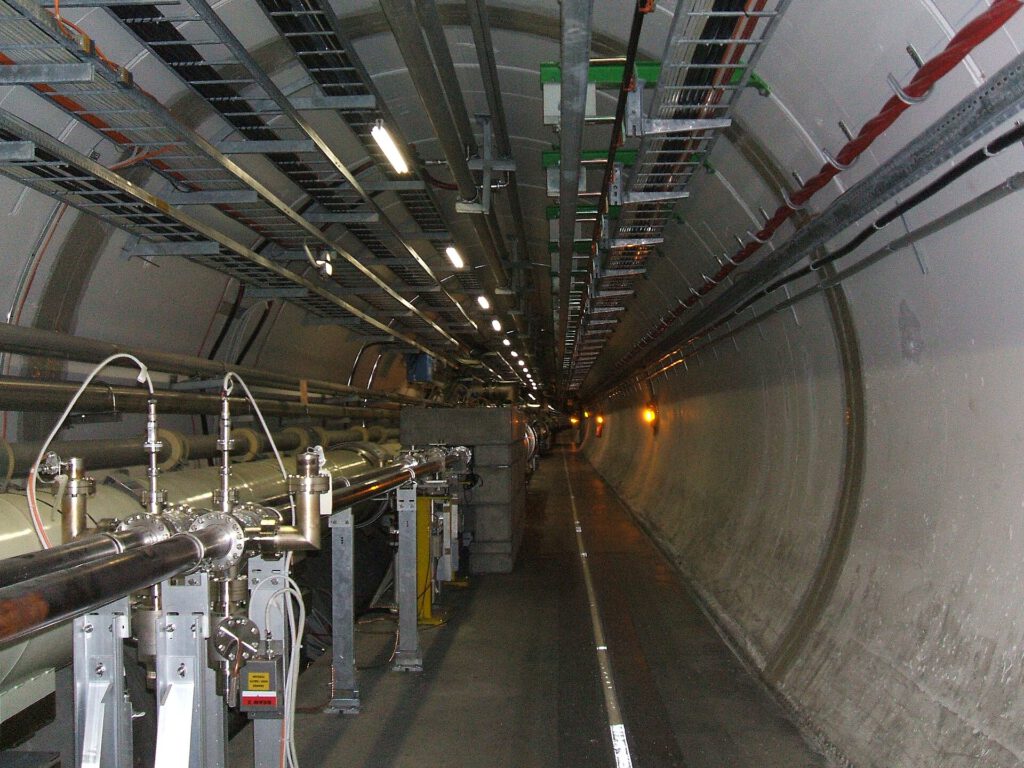
Mesons are subatomic particles that form during high-energy collisions and exist for only a fraction of a second before transforming. Muons are similar to electrons but carry approximately 200 times more mass. By studying how these particles decay, researchers test the boundaries of current physics theories. The recent observation aligns with existing predictions, but the ability to detect it at all is a significant technical achievement.
Upgrades Enable New Precision
The detection of this phenomenon became possible following major upgrades to the Large Hadron Collider in 2024. These improvements allowed for faster data collection rates, which are essential for capturing such infrequent events. Additionally, researchers applied new machine-learning techniques to filter out background processes. These algorithms suppressed the vast amount of data that would otherwise have obscured the signals from the rare beauty-particle decays.
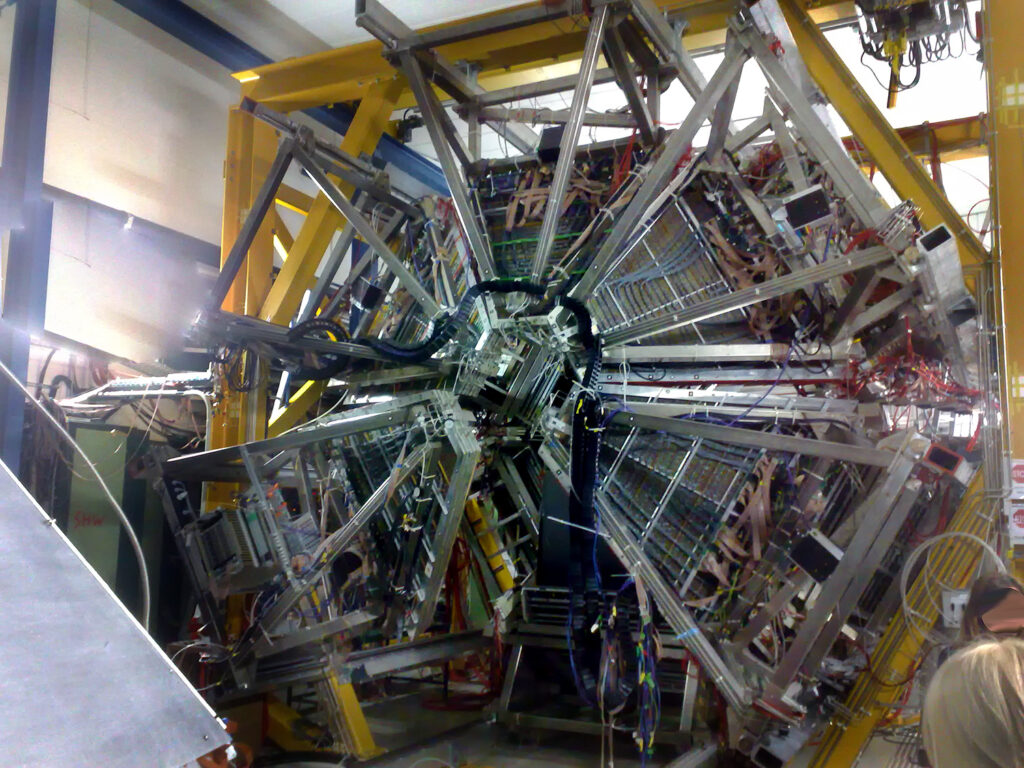
The zeptoverse describes distances where a typical atom appears roughly 100,000 million times larger. To visualize this scale, the difference between a human and a single skin cell is comparable to the difference between a human and an atom. While the current results fit within the standard model, future measurements at this scale may reveal phenomena that defy current expectations. This opens a new avenue for investigating the limits of observable physics.
Beyond the zeptoverse lies the Planck length, a scale 60 trillion times smaller. This is the smallest unit theoretically possible in physics. Scientists do not yet know if physical structures exist at this level, as known laws of physics likely break down there. Understanding this regime could provide insights into the first infinitesimal fraction of a second after the Big Bang, when the entire universe was compressed to such microscopic proportions.

The details of this analysis are currently available as a preprint on arXiv. The research team continues to refine their measurements to determine if any deviations from the standard model appear at these extreme scales.
Source: Wired
