


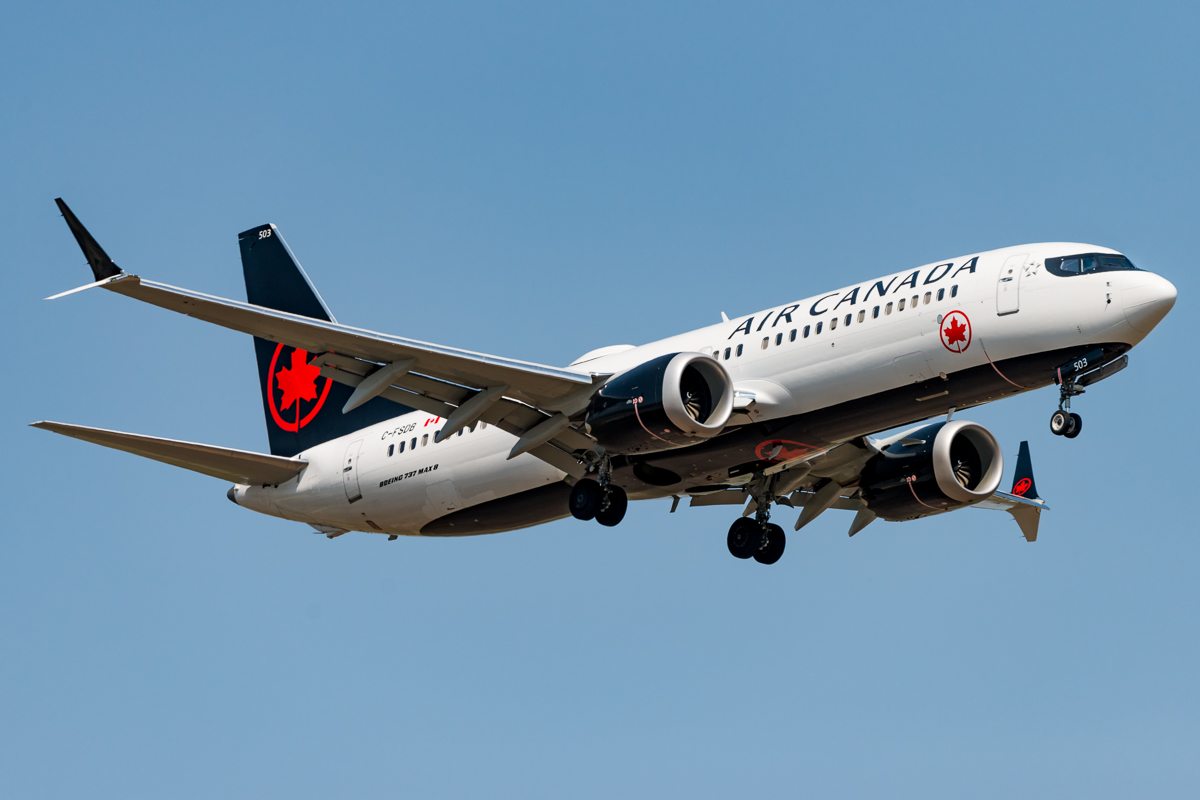
An Air Canada Boeing 737 MAX 8 received a Traffic Collision Avoidance System (TCAS) alert after encountering an unresponsive Cessna while climbing out of Palm Springs International Airport (PSP) last week. The incident occurred on November 17, when flight AC1769, bound for Vancouver International Airport (YVR), was ascending through approximately 11,400 feet. The automated system issued a resolution advisory, prompting the pilots to climb to 12,000 feet to establish greater vertical separation from the nearby smaller aircraft.
TCAS Resolution Advisory at 11,400 Feet
According to AIRLIVE, the Air Canada aircraft departed Palm Springs at 12:45 PM local time on Runway 31R. The plane, registered as C-FSDB, began its climb toward cruising altitude when its onboard surveillance equipment detected potentially conflicting traffic. The TCAS resolution advisory (RA) instructed the crew to modify their vertical flight path to address the potential collision threat. This maneuver added 600 feet to their altitude, moving the aircraft from 11,400 feet to 12,000 feet.
A resolution advisory differs from a standard traffic advisory by providing direct instructions to climb or descend. Unlike guidance from air traffic controllers, these alerts are generated automatically using onboard transponder data. The Federal Aviation Administration’s Aeronautical Information Manual states that pilots are expected to follow an RA promptly unless doing so would jeopardize the aircraft’s safety. In this case, the Air Canada crew executed the climb without delay.
Unresponsive Cessna and Unknown Separation
The encounter involved a small Cessna that reportedly failed to respond as the Canadian aircraft climbed. However, specific details regarding the Cessna’s identity, registration, and the nature of any communication attempts remain unknown. AeroSillage noted that available reporting does not establish whether the smaller aircraft failed to answer a radio transmission or did not comply with an air traffic controller’s instruction. The exact distance between the two aircraft when the alert occurred has also not been disclosed.
Despite the automated warning, the Air Canada flight continued its scheduled journey without diverting or returning to the airport. The aircraft landed safely at Vancouver International Airport at 4:45 PM local time, completing the approximately two-hour-and-40-minute trip. Flight-tracking information independently confirms that the 737 MAX 8 operated the Palm Springs-Vancouver service and reached its destination without further emergency involvement.
Aviation Safety and Investigation Status
This incident highlights the critical role of onboard collision-avoidance technology in busy airspace. TCAS uses information transmitted by nearby aircraft transponders to identify potential threats. When aircraft operate in close proximity, the system can issue traffic advisories or resolution advisories to maintain safe vertical separation. The successful execution of the RA by the Air Canada crew demonstrates the effectiveness of these automated safeguards.
As of now, no specific findings from US or Canadian authorities have been released to establish the full circumstances of the encounter. Without an official reconstruction, it remains impossible to determine the precise cause of the Cessna’s unresponsiveness or the minimum separation achieved between the two planes. The incident serves as a reminder of the unpredictable nature of air traffic, even during routine departures.
Source: Simple Flying
