


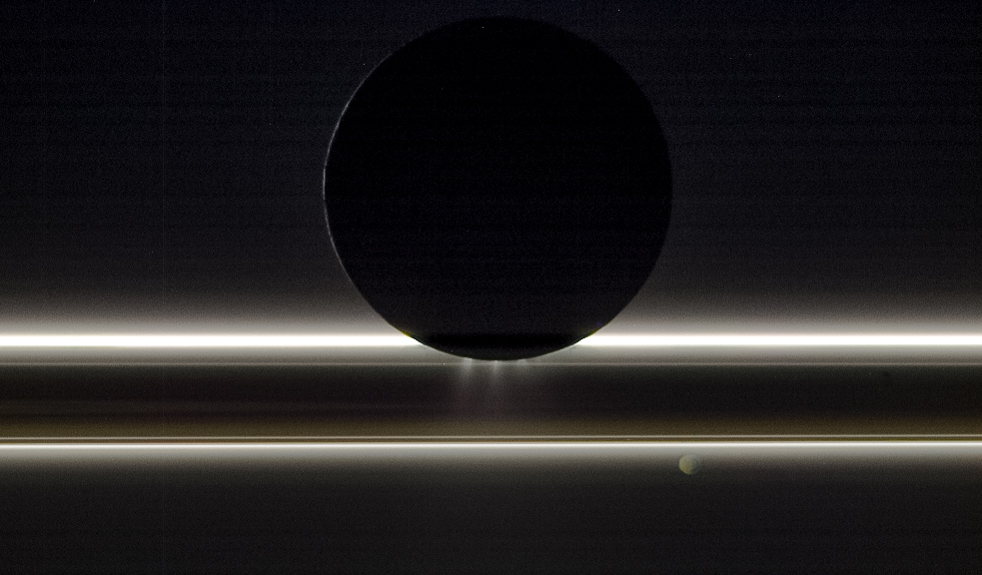
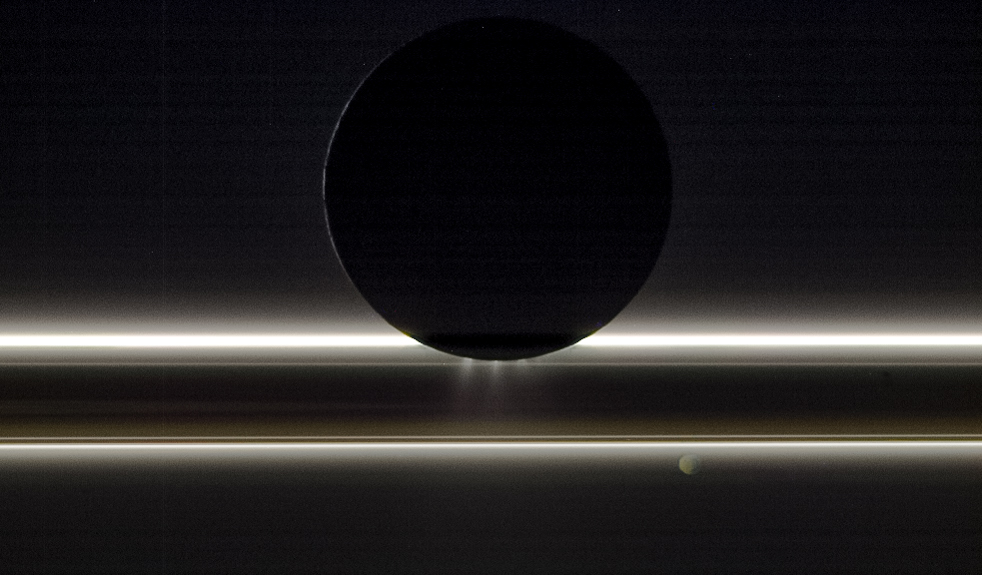
Astronomers continue to study one of the most intriguing bodies in our solar system, Enceladus, through archival imagery from the Cassini spacecraft. A striking photograph taken on November 1, 2009, places the moon directly between the camera and the Sun. This backlighting creates a dramatic silhouette that highlights the dynamic activity occurring at the moon’s south pole.
Backlit View of Icy Plumes
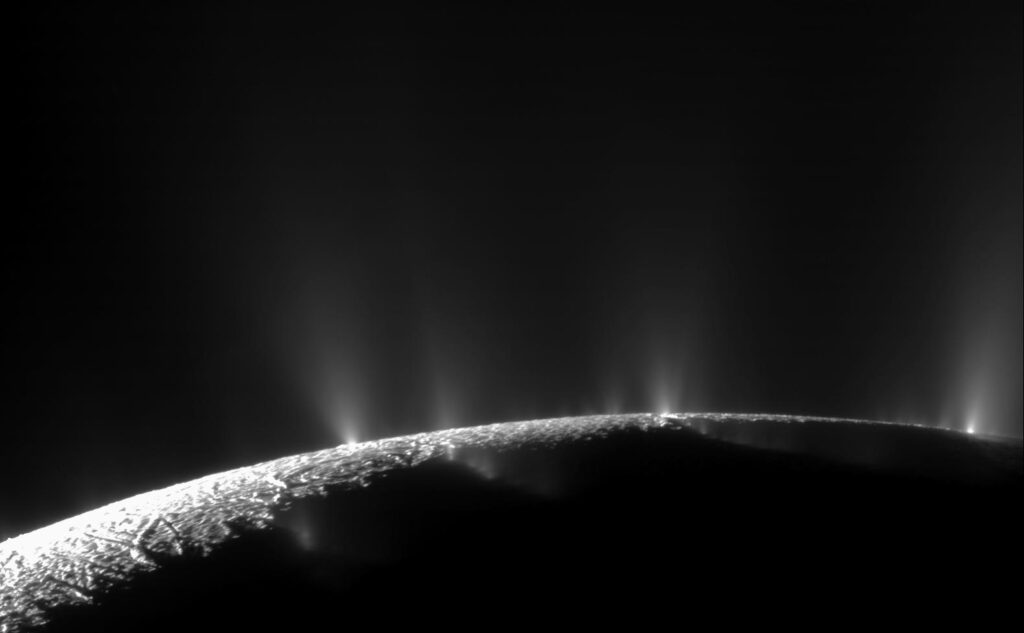
The image captures the moment when sunlight filters through the material erupting from Enceladus. These plumes are not static features but are part of a continuous process. Water ice and other volatiles are ejected into space, creating a visible halo around the moon’s southern region. The Cassini mission first detected these geysers in 2005, fundamentally changing our understanding of the small Saturnian moon.
The 500-kilometer diameter moon appears dark against the bright solar disk. However, the edges of the plumes glow as they scatter the sunlight. This perspective allows scientists to map the extent and density of the ejected material. The scene also includes Saturn’s rings, which stretch across the frame. These rings scatter sunlight toward the spacecraft, adding depth to the composition and providing context for the moon’s orbital environment.
Connection to Subsurface Ocean
The source of these plumes is believed to be a global ocean trapped beneath Enceladus’s icy crust. The pressure from this subsurface water forces it through fractures in the ice shell, where it freezes and expands into space. This process not only shapes the moon’s surface but also replenishes Saturn’s outer E ring with fresh ice particles.
The material supplied by Enceladus makes its surface highly reflective, comparable to fresh snow. This high albedo affects how the moon interacts with sunlight and influences its thermal balance. The continuous supply of ice from the plumes ensures that the E ring remains populated, even as particles are gradually removed by radiation pressure and gravitational forces.
Beyond the main rings, the image reveals another small moon, Pandora. With a diameter of approximately 80 kilometers, Pandora is faintly visible in the lower right corner. It is illuminated by Saturnlight, the sunlight reflected off Saturn’s massive disk. This subtle lighting highlights the complex interplay of light sources in the Saturnian system, where multiple bodies contribute to the illumination of each other.
The Cassini mission provided unprecedented data on Enceladus, confirming the presence of liquid water and organic compounds. These findings have made Enceladus a primary target in the search for habitable environments beyond Earth. The 2009 image remains a key visual record of the moon’s active geology, illustrating the powerful forces at work beneath its frozen exterior.
Source: NASA
