


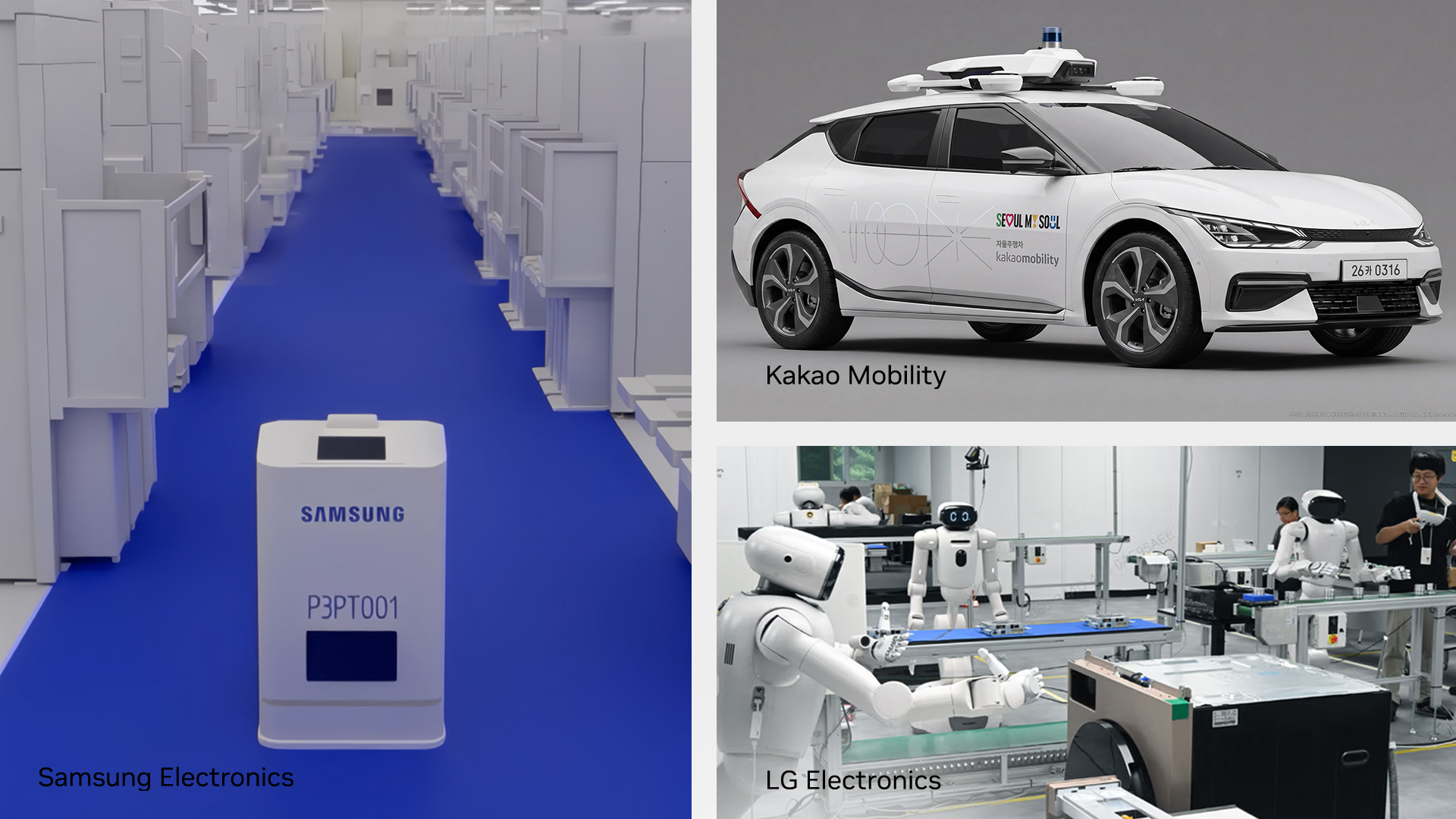
NVIDIA is expanding its physical AI ecosystem in South Korea by partnering with major domestic industry leaders. The collaboration aims to move artificial intelligence from theoretical development into real-world production environments. Samsung Electronics, Kakao Mobility, and LG Electronics are applying accelerated computing and simulation technologies to their core operations.
Samsung Accelerates Semiconductor Design With AI
Samsung Electronics is deepening its partnership with NVIDIA to enhance semiconductor innovation. The work covers materials research, process development, and device engineering. Samsung is utilizing NVIDIA cuISS and NVIDIA cuDSS to speed up computations involving sparse linear systems in technology computer-aided design. The companies are also exploring GPU acceleration for process and optical simulations.
In materials research, Samsung’s sMOL platform has achieved significant performance gains. The platform ran selected quantum chemical calculations up to five times faster end-to-end using NVIDIA cuEST. Samsung is also investigating NVIDIA cuEquivariance to accelerate tensor operations for atomistic AI models used in training and inference.
The collaboration extends to chip-scale thermal and mechanical analysis workflows using NVIDIA PhysicsNeMo. In one specific case involving AI homogenization, the combination of AI-predicted material properties, coarser grids, and GPU acceleration resulted in a 1,600x speedup. Simulation time dropped from approximately 18 hours on a 32-core CPU to just 41 seconds on a GPU-accelerated coarse-grid solve. Future efforts may involve the NVIDIA Agent Toolkit to connect these simulation tools and AI models for automated engineering analysis.
Kakao Mobility Targets Level 4 Autonomous Driving
Kakao Mobility is leveraging NVIDIA’s autonomous vehicle computing and safety technologies to develop a level 4 autonomous driving system. The project combines Kakao Mobility’s proprietary driving software and its experience operating in Seoul’s Gangnam district with NVIDIA’s vehicle computing platform. The company plans to use NVIDIA Hyperion, a reference platform for vehicle sensors and compute powered by NVIDIA DRIVE AGX Thor.
NVIDIA Halos will support safety validation across the development lifecycle. Initial development will focus on Kia purpose-built vehicles, integrating Kakao Mobility’s software with NVIDIA technologies. The goal is to support future level 4 mobility services within Korea.
LG Electronics Demonstrates Robotic Manufacturing
NVIDIA and LG Electronics successfully demonstrated robotic manipulation and manufacturing tasks using LG’s CLOiD robot. The demonstration utilized NVIDIA Isaac GR00T in an actual manufacturing environment. The collaboration established a physical AI data flywheel that connects real-world data collection, NVIDIA Cosmos-based data augmentation, GR00T model training, NVIDIA Jetson AGX Thor onboard computing, and simulation-based evaluation.
This workflow allows for the continuous refinement of robotic capabilities. The teams are using this process to create a repeatable method for training, evaluating, and improving robots for industrial manufacturing applications.
Source: NVIDIA
