


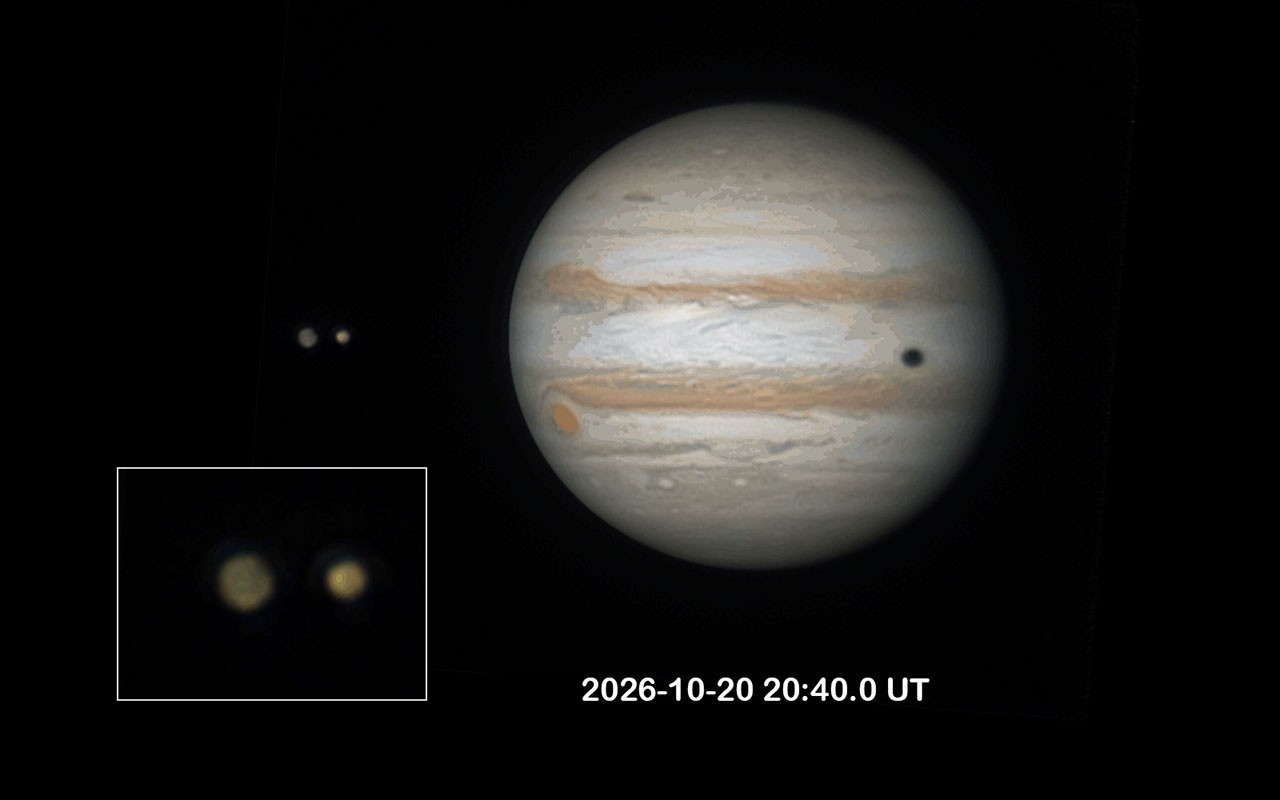
Astronomers and space enthusiasts have a new visual record of a rare celestial alignment. The NASA Astronomy Picture of the Day for October 28, 2026, features a video capturing the mutual occultation of Ganymede and Io. This event occurred on October 20, 2026, when the two moons crossed paths in the sky above Jupiter.
Rare Alignment of Galilean Moons
The video highlights a moment where Ganymede briefly blocked Io from view. This type of astronomical event, known as a mutual occultation, happens when one object passes in front of another, partially or completely obscuring it. While Jupiter hosts a large number of natural satellites, these specific crossings are not common sights.
Jupiter currently has 115 discovered moons orbiting it. Saturn holds the record with 293 known moons. Among Jupiter’s many satellites, Ganymede and Io are two of the four Galilean moons. These moons are named after the astronomer Galileo Galilei, who first observed them in the early 17th century. The mutual occultations of these Galilean moons are particularly rare to witness from Earth.
The rarity stems from the geometry of the solar system. For these events to occur, Earth must have an edge-on view of Jupiter’s orbital plane. This specific alignment happens only once every six years. It coincides with Jupiter’s equinox, a time when the planet appears less tilted from our perspective. This geometric shift allows observers on Earth to see the moons pass directly in front of or behind one another.
Shadows and Solar Eclipses
The APOD video also reveals another detail of the event. Ganymede is shown casting its shadow on the right side of Jupiter. This shadow creates a dark spot moving across the planet’s cloud tops. The presence of this shadow indicates that the sun is illuminating the scene from a specific angle relative to the observer.
The source text notes that any fictional Jovian species located within that shadow would be experiencing a solar eclipse. While no such species exist, the description highlights the dramatic scale of the event. The shadow of a moon like Ganymede can stretch across the vast atmosphere of the gas giant.
The NASA Astronomy Picture of the Day project features a different image or photograph of the universe each day. Each entry includes a brief explanation written by a professional astronomer. This daily feature aims to help the public discover the cosmos through visual media and expert commentary. The October 28 entry serves as a follow-up to the October 20 event, providing a recorded view of the occultation.
The next day’s picture, scheduled for October 29, 2026, will feature a planet that grows horns. This continues the series’ tradition of showcasing diverse and striking astronomical phenomena. The current focus remains on the precise timing and visual clarity of the Ganymede and Io crossing.
The event underscores the dynamic nature of the Jovian system. Even with 115 moons orbiting the planet, the specific alignment required for a mutual occultation is a fleeting opportunity. The video provides a clear record of this moment, preserving the visual data for future study and public appreciation.
Source: NASA
