


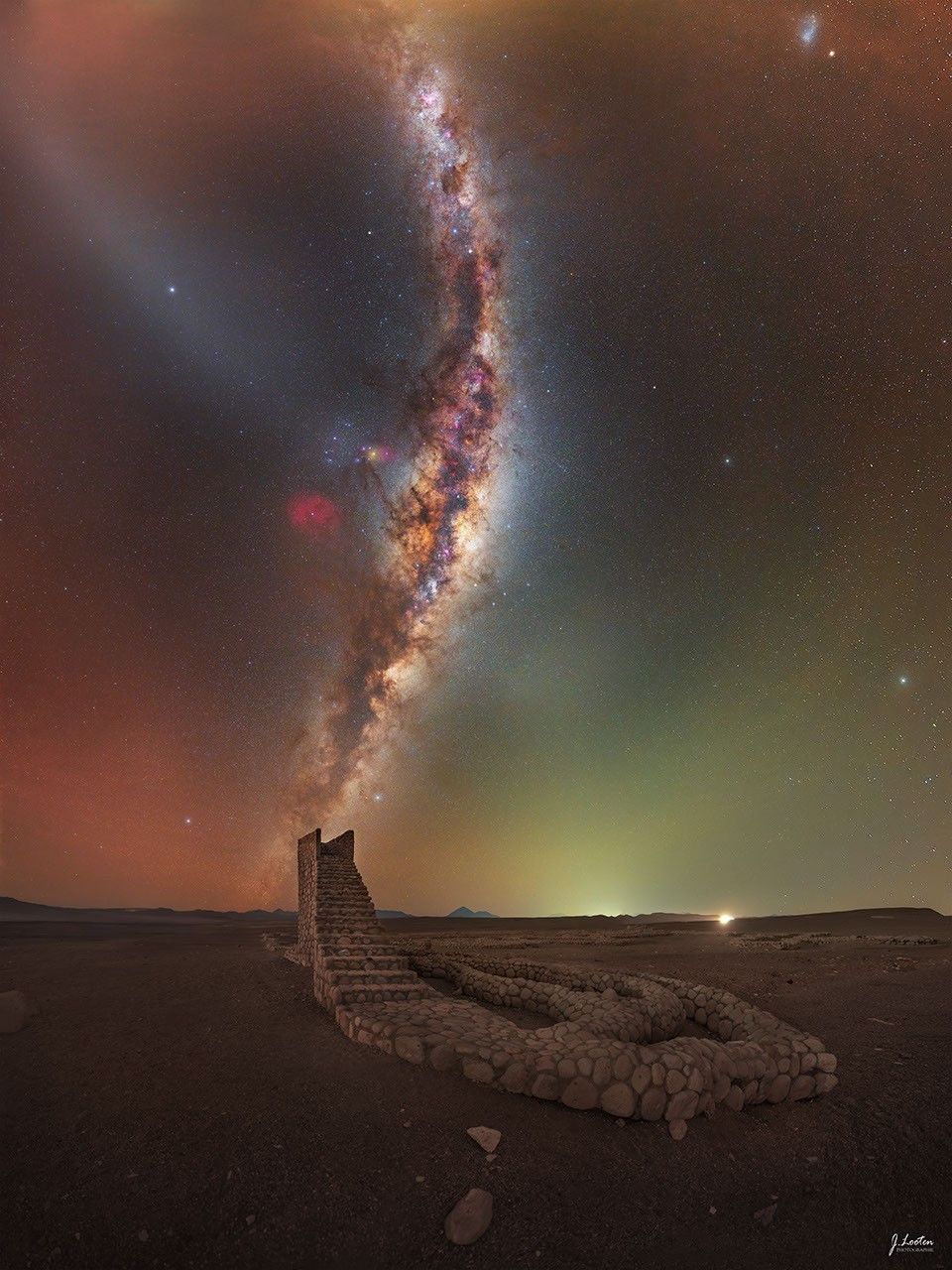
A composite image captured in July 2025 presents a striking view of the night sky above Chile’s Atacama Desert, featuring the prominent Desert Staircase sculpture in the foreground. The photograph was timed to align the near-vertical band of the Milky Way galaxy with a specific vantage point on the installation, creating a visual connection between the man-made structure and the celestial backdrop.
Atacama Desert Milky Way and Celestial Features
The image reveals several distinct astronomical phenomena visible from this location. The dark lane of the Milky Way galaxy rises prominently behind the expansive desert landscape. To the upper left, a band of zodiacal light is visible, a faint glow caused by sunlight reflecting off interplanetary dust. Within this stripe of light, the star Spica can be identified.
Just above the horizon, green and red airglow adds color to the lower sky. At the very top right of the frame, the Small Magellanic Cloud galaxy appears as a distinct, fuzzy patch. These elements combine to create a complex scene that highlights the clarity of the Atacama sky.
Foreground and Horizon Details
The Desert Staircase sculpture dominates the foreground, providing a geometric contrast to the organic shapes of the sky. The composition places the viewer on a perch just in front of the Milky Way band, emphasizing the scale of the galaxy relative to the human-made structure.
Along the horizon, specific geographical features are visible from left to right. The Andes Mountains form a rugged silhouette, followed by the Licancabur volcano. Further to the right, the lights of the town of San Pedro de Atacama dot the darkness, indicating human presence in this remote region.
This daily featured image, accompanied by an explanation from a professional astronomer, offers a detailed look at the intersection of terrestrial landmarks and cosmic structures. The next featured image will focus on open space.
Source: NASA
